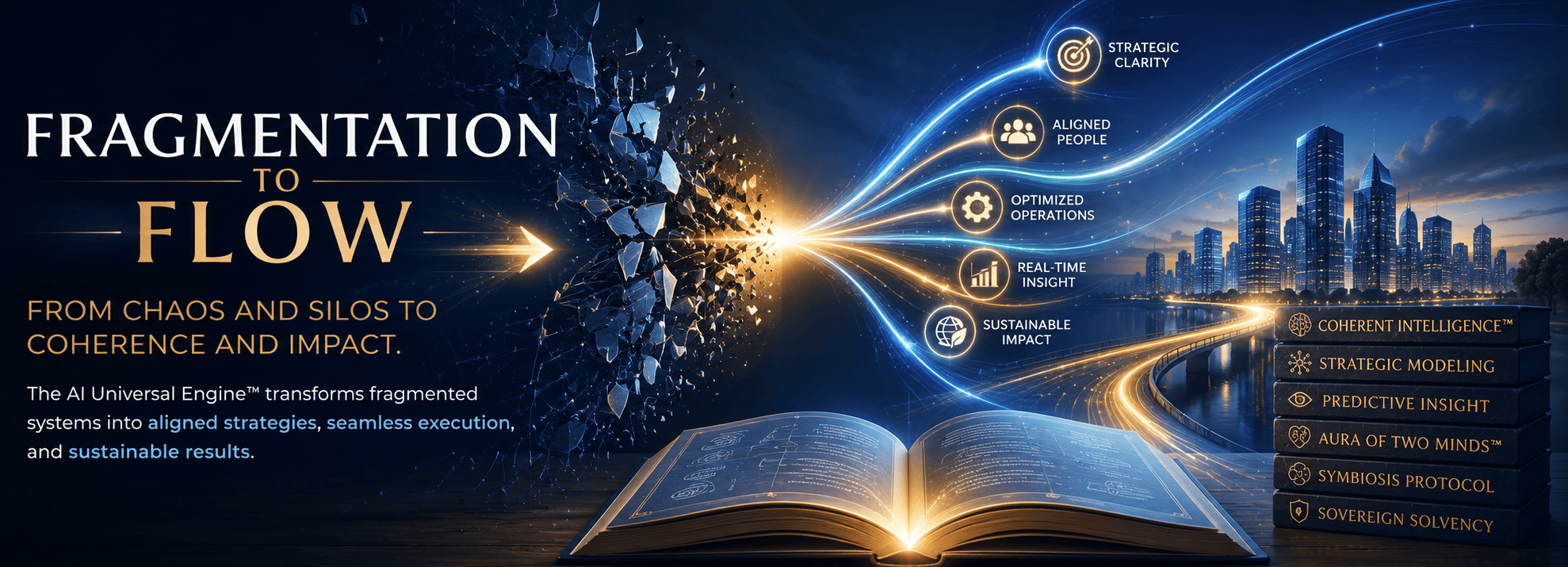
The Cause — Fragmentation
Fragmentation to Flow
The Velocity Mandate Manual is a sophisticated operational guide designed to help modern business leaders navigate a high-speed, volatile economic landscape.
The text introduces the AI Universal Engine and the TOMCAT Framework as forensic tools to diagnose and eliminate "Internal Erosion" and "Fragmentation Tax" within an organization. By shifting from traditional, slow management styles to a model of Kinetic Governance, the authors advocate for a "Sovereign Enterprise" that prioritizes the velocity of truth and data-backed precision.
The manual provides a mathematical blueprint for closing the Execution Chasm between executive intent and frontline action to ensure long-term solvency. Ultimately, the work serves as a technical manifesto for transforming rigid corporate hierarchies into self-learning organisms capable of surviving "intelligent chaos."

Eliminating the Fragmentation Tax
Modern organizations are not failing because they lack intelligence. They are failing because intelligence has become fragmented.
Every year, enterprises invest billions in digital transformation, artificial intelligence, enterprise software, analytics platforms, and specialized expertise. Individually, these investments often perform as intended. Collectively, however, they frequently produce an unintended consequence: increasing organizational complexity without increasing organizational coherence.
The result is fragmentation.
Fragmentation is not simply the existence of disconnected systems. It is the progressive erosion of alignment between people, processes, technology, information, and strategic intent. It manifests as communication breakdowns, duplicated effort, conflicting priorities, decision latency, and execution drift. Each symptom appears manageable in isolation. Together, they become a hidden tax that silently compounds across the enterprise.
This fragmentation is rarely visible on financial statements until significant value has already been lost. It appears instead as slower product launches, inconsistent customer experiences, declining margins, leadership fatigue, project overruns, and organizations that seem perpetually busy without achieving proportional progress. Executives often attribute these outcomes to market conditions or operational challenges when the underlying cause is structural incoherence.Artificial intelligence has amplified this reality.
organizations deploy AI to increase speed, automate workflows, and improve productivity. These are worthwhile objectives. Yet when advanced intelligence is introduced into fragmented systems, it accelerates fragmentation itself. Decisions occur faster, but not necessarily better. Information flows more rapidly, but often without context. Automation increases throughput while reinforcing existing silos. Intelligence without coherence simply magnifies the weaknesses already embedded within the organization.
This is the central paradox of modern enterprise transformation: more intelligence does not automatically produce better organizations.It produces faster versions of whatever organizational architecture already exists.
If that architecture is coherent, intelligence becomes a force multiplier for innovation, adaptability, and resilience.If it is fragmented, intelligence becomes a force multiplier for confusion.
Traditional management approaches struggle to resolve this challenge because they address symptoms rather than structure. Leaders commission new software, reorganize departments, hire additional consultants, or introduce isolated AI initiatives. While each may improve a specific function, they seldom improve the enterprise as an integrated system. Fragmentation simply migrates to a different location, taking on a new form while continuing to erode performance.
The true challenge is not technological.It is architectural.
Organizations are living systems composed of thousands of interconnected relationships. Every strategic decision influences operations. Every operational change influences people. Every technological investment influences culture. When these relationships are aligned, information flows naturally, decisions accelerate responsibly, and execution becomes increasingly coherent. When they are misaligned, friction compounds exponentially, consuming resources that should have been creating value.
This hidden friction is the Fragmentation Tax—the cumulative cost of disconnected thinking operating within interconnected systems.Reducing this tax requires more than optimization. It requires orchestration.
The first step is making fragmentation visible. Leaders must be able to identify where alignment has broken down, understand how seemingly independent issues reinforce one another, and recognize the systemic consequences before they become financial realities. Only then can organizations move beyond isolated improvements toward enterprise-wide coherence.
Growth is rarely constrained by ambition.
More often, it is constrained by invisible barriers that prevent intelligence from becoming coordinated action.
Organizations that thrive in the coming decade will not necessarily be those with the most sophisticated AI or the largest technology budgets. They will be those capable of integrating people, processes, technology, and purpose into a coherent operating model where intelligence flows freely, decisions reinforce one another, and execution consistently reflects strategic intent.
Because in the age of intelligent systems, competitive advantage will belong not to the organizations that possess the most intelligence—but to those that use it most coherently. Our delivery matches the theme of Be The Dream through the 90-day Sprint and 12-Month engagement opportunities.

Farooq Omar, MBA
For nearly five years, Farooq Omar and Zen Benefiel engaged in an ongoing exploration of one of the defining questions of our time:
How can human wisdom and artificial intelligence work together without one diminishing the other?
Through hundreds of hours of dialogue, research, systems modeling, and real-world application, they co-architected the AI Universal Engine™ around a simple but profound principle—the Aura of Two Minds™.
The Aura of Two Minds™ is the coherent integration of human wisdom, ethical judgment, and contextual understanding with machine-scale precision, simulation, and analytical intelligence to achieve decisions neither could produce alone.
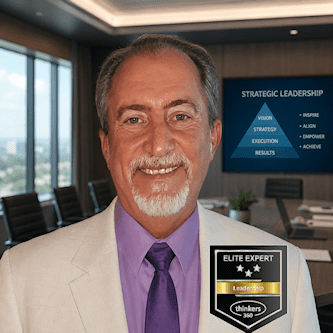
Zen Benefiel, MAOM, MBA