Built Before We Branded It
AI Universal Engine™ was developed independently, without institutional funding or outside investment. While billions are being spent on LLMs, branding, and polished digital experiences, we chose to invest our time and resources in the intelligence itself—building, testing, and refining the methodology before the marketing. What you see here reflects that priority. We built the engine before the showroom. Now we’re inviting organizations, partners, and investors to examine what it can do.
See Clearly. Decide with Confidence. Execute with Coherence.
How do humans and AI become more coherent together?
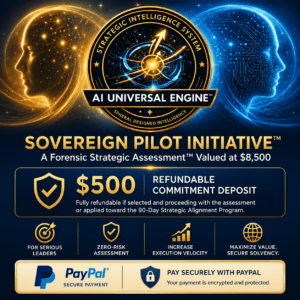
Results in 5 days or less - What traditional consulting can't do in 90. $8500 vs $75k or more.
Strategic and forensic insight in five days or less—supported by a governed path from recommendation to execution.
What Is The AI Universal Engine™? Why do you need it?
Enterprise Risk Management
In five days or less, the AIUE™ performs a strategic stress test assessment—analyzing the enterprise across financial, operational, leadership, workforce, process and strategic dimensions, then compiles and synthesizes those findings into an actionable executive roadmap.
The stress test assessment provides a depth of organizational intelligence previously only affordable primarily through expensive and lengthy consulting engagements and makes it accessible, repeatable and scalable on-demand. The AI Universal Engine™ offers a clear path forward after stress-testing thousands of potential scenarios including climate, market and world events. Click to download the Executive Overview.
Built-in AI governance defines the authority, evidence, policy, scope, exposure and material conditions that must remain satisfied before consequential action proceeds. The expertise of over thirty years of deterministic AI coding, global strategic systems consulting and understanding went into the AI Universal Engine™. Even the best consulting firms cannot offer that, though the inclusion of the AIUE would exponentiate their service capacity.
Five-day assessment results: $8,500 vs. 90-day traditional consulting results. No cash burn.
Explore the Path to Coherent Resilience
Practical guides to strengthen alignment, navigate change, and turn insight into action.
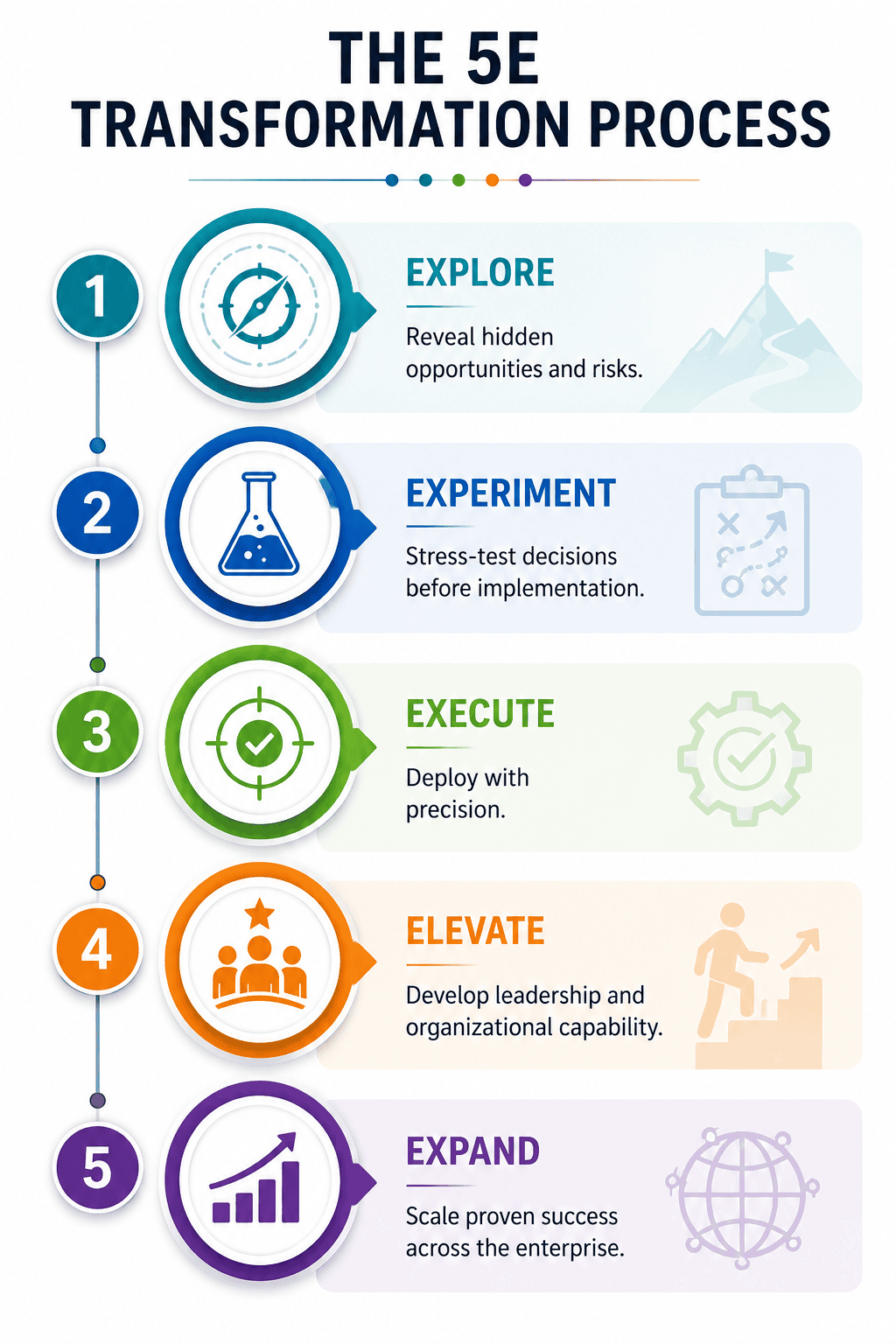
Every organization makes decisions, but the real competitive advantage is how quickly the right decisions become coordinated action. Decision latency—the gap between recognizing a need and acting on it—quietly compounds risk, consumes resources, delays opportunities, and widens the distance between strategy and execution
From Information to Intelligent Action
More information does not necessarily create better decisions. Leaders are often surrounded by reports, dashboards, meetings, and competing priorities while the critical relationships between them remain hidden. AI Universal Engine™ connects these signals across the enterprise, revealing patterns, dependencies, and emerging risks that conventional analysis can miss.
Compressing the Decision Cycle
Through strategic modeling, scenario exploration, and AI-assisted analysis, AIUE™ helps leaders examine alternatives before committing resources. The result is a shorter path from Signal → Insight → Decision → Coordinated Action, reducing costly delays while improving clarity and organizational alignment.
Human Judgment. Machine Intelligence.
From Analytical Support to Governed Execution
AIUE identifies which strategic pathways are supported by the available evidence, assumptions and scenario analysis. Its findings do not independently authorize consequential action.
Where execution governance is included, configured conditions are revalidated when execution is requested. Human leaders retain authority and accountability throughout the process.
The Aura of Two Minds™ combines the speed and pattern-recognition capabilities of AI with human experience, intuition, ethics, and accountability. This Coherent Intelligence™ approach doesn't replace leadership—it strengthens the leader's ability to recognize what matters and act while the opportunity still matters.
Where Is The AI Universal Engine™ Opportunity?
Enterprises, Institutions & Nonprofits
The AI Universal Engine™ (AIUE™) is a strategic intelligence system that combines human judgment with AI-powered analysis to reveal hidden organizational friction, evaluate risk, simulate strategic options, and align strategy with execution.
Rather than examining finance, operations, leadership, technology, and workforce performance as separate concerns, the AIUE™ evaluates how they interact as one organizational system.
This allows leaders to see how a delayed decision, misaligned role, inefficient process, or overlooked financial vulnerability can create consequences elsewhere in the organization.
Its diagnostic architecture identifies patterns that conventional reports and isolated metrics may miss. Leaders can then explore alternative decisions through strategic simulation, compare possible outcomes, and determine where intervention may create the greatest leverage before committing significant resources.
Who Is The AI Universal Engine™ Target Market?
Organizational Leadership & Boards
The AI Universal Engine™ is designed for CEOs, CFOs, COOs, executive teams, boards, and mission-driven leaders responsible for navigating growth, disruption, financial pressure, operational complexity, or organizational transformation.
It supports CEOs, CFOs, COOs, boards, and leadership teams across businesses, nonprofits, educational institutions, government agencies, and mission-driven initiatives.
It is especially valuable when operations become fragmented, decisions take too long, resources are strained, leadership priorities conflict, or strategic plans repeatedly fail to produce consistent results.
The AIUE™ is best suited for leaders willing to examine the underlying causes of organizational friction and consider how finance, operations, people, technology, and strategy affect one another.
By revealing hidden risks, systemic dependencies, and high-leverage opportunities, it provides a stronger foundation for allocating resources, evaluating major decisions, strengthening accountability, and creating a more coherent path from strategic intention to measurable execution.
What Problem Does The AI Universal Engine™ Solve?
Expose & Reduce Execution Chasm
It is particularly valuable for businesses, nonprofits, institutions, government agencies and cross-sector initiatives experiencing fragmented operations, delayed decisions, leadership misalignment, resource inefficiency or a persistent gap between strategy and execution.
Organizations face two costly disconnects. The Execution Chasm™ prevents strategy from becoming coordinated action, while the Approval-Execution Gap emerges when authority, evidence, exposure, policy or market conditions change between approval and execution.
Conventional reports often examine functions separately and decisions only at a single moment, leaving leaders with visible symptoms but limited understanding of the relationships and changing conditions beneath them.
The AI Universal Engine™ addresses both gaps through an integrated approach: its Analytical Core reveals systemic friction and identifies evidence-supported strategic pathways, while the Execution-Governance Layer revalidates whether consequential actions remain admissible when execution is requested.
Through the Aura of Two Minds™, machine intelligence contributes analytical speed, pattern recognition and systems visibility, while human leaders retain purpose, ethics, context, authority and accountability—producing Coherent Intelligence™ from strategic intention through governed execution.
How Does It Work?
AIUE™ Executive Brief
The AI Universal Engine™ brings together relevant financial, operational, strategic, technological, and human-performance data to create an integrated view of the organization.
The integrated approach operates through two complementary layers:
AIUE Analytical Core
Examines financial, operational, organizational and market conditions; identifies systemic friction; compares strategic alternatives; and produces a structured decision package supported by evidence references and documented assumptions.
Execution-Governance Layer
Revalidates configured authority, evidence, policy, scope, exposure, material conditions and time-validity requirements before a consequential action proceeds.
Depending on the resulting condition state, the action may receive one of four dispositions:
ALLOW: Eligible to proceed under the configured governance profile.
HOLD: Paused pending refreshed or reconciled information.
DENY: Prevented from proceeding under the current request.
ESCALATE: Routed for higher-tier authority or human review.
An ALLOW disposition indicates that configured governance conditions remain satisfied. It does not guarantee the business outcome.
What Information Does It Analyze?
No More Analysis Paralysis
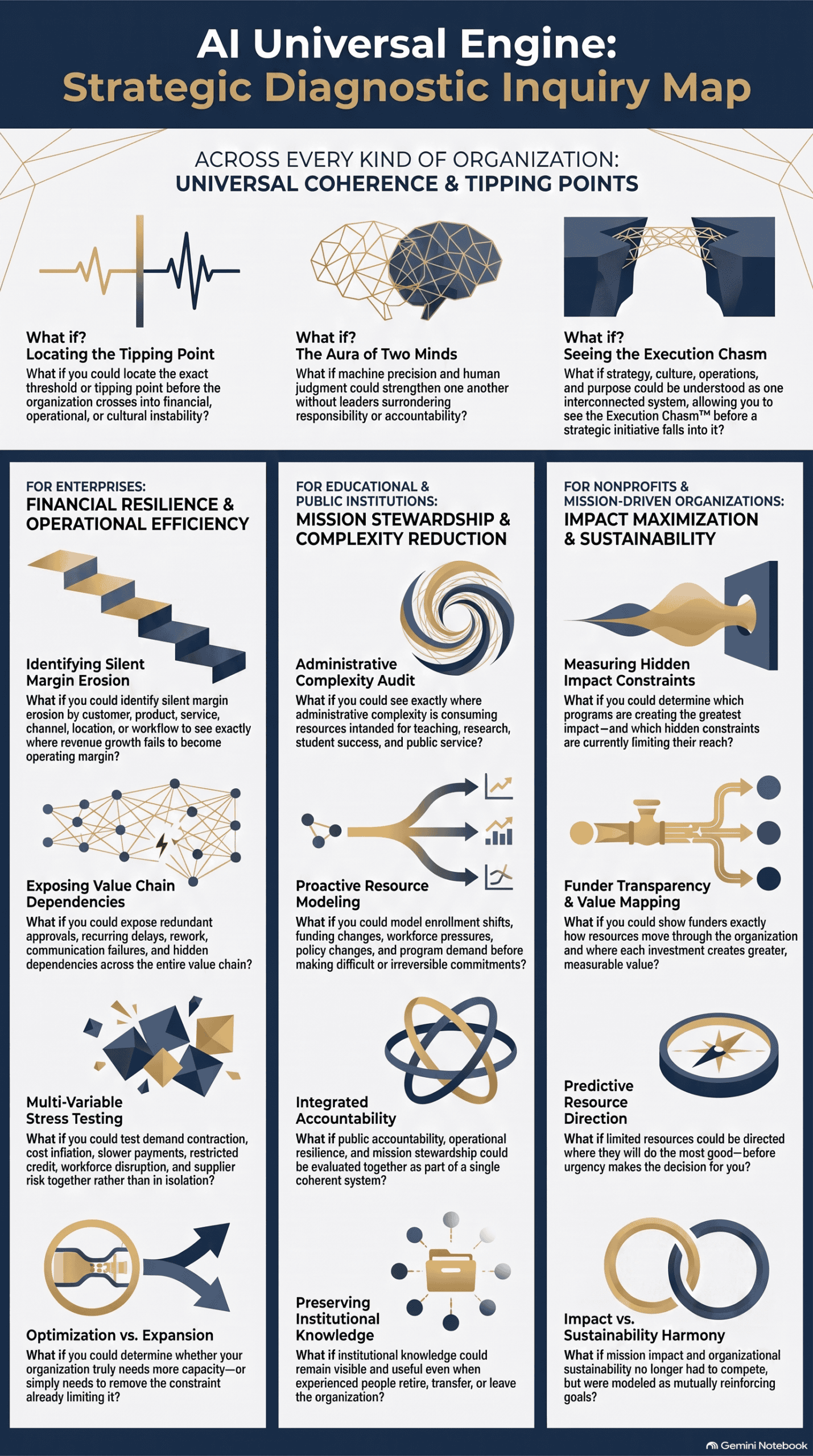
The AI Universal Engine™ analyzes information across the organization, including financial performance, operational workflows, strategic priorities, leadership capacity, workforce alignment, decision pathways, resource allocation, customer and stakeholder experience, technology integration, and market conditions.
Information may come from financial statements, performance reports, organizational charts, policies, surveys, interviews, process documentation, operational systems, market conditions, and leadership observations.
The specific inputs depend on the organization and purpose of the assessment. Each assessment defines which information is required, where it originated, how current it is, which assumptions apply and what limitations affect interpretation. Where governance controls are included, evidence freshness and sufficiency may be revalidated before consequential execution.
Rather than evaluating each information source separately, the AI Universal Engine™ examines how conditions across the organization interact, influence one another, and contribute to performance, vulnerability, resilience, or emerging opportunity.
The AIUE™ then uses strategic modeling and “what-if” simulations to compare potential decisions before significant resources are committed.
Leaders review the findings with a trained human navigator who contributes context, ethical judgment, organizational insight, and implementation guidance.
The result is a prioritized analytical roadmap indicating what may need attention, where intervention may create leverage and which findings require leadership review, further evidence or controlled validation.
By synthesizing quantitative data with qualitative human insight, the AI Universal Engine™ helps leaders recognize patterns that isolated metrics may overlook.
It can reveal how a delayed decision, unclear responsibility, inefficient process, financial weakness, or workforce misalignment creates consequences elsewhere in the system.
This allows leadership to distinguish visible symptoms from underlying causes and identify where focused action may produce the greatest strategic and operational improvement.
By identifying these patterns, the AIUE™ helps close the Execution Chasm™—the gap between what leadership intends to accomplish and what the organization consistently delivers.
It gives decision-makers a clearer understanding of where intervention can create the greatest leverage, enabling them to align resources, strengthen accountability, reduce avoidable risk, and translate strategy into coordinated action with greater speed, confidence, and measurable effectiveness.
What Does Leadership Receive?
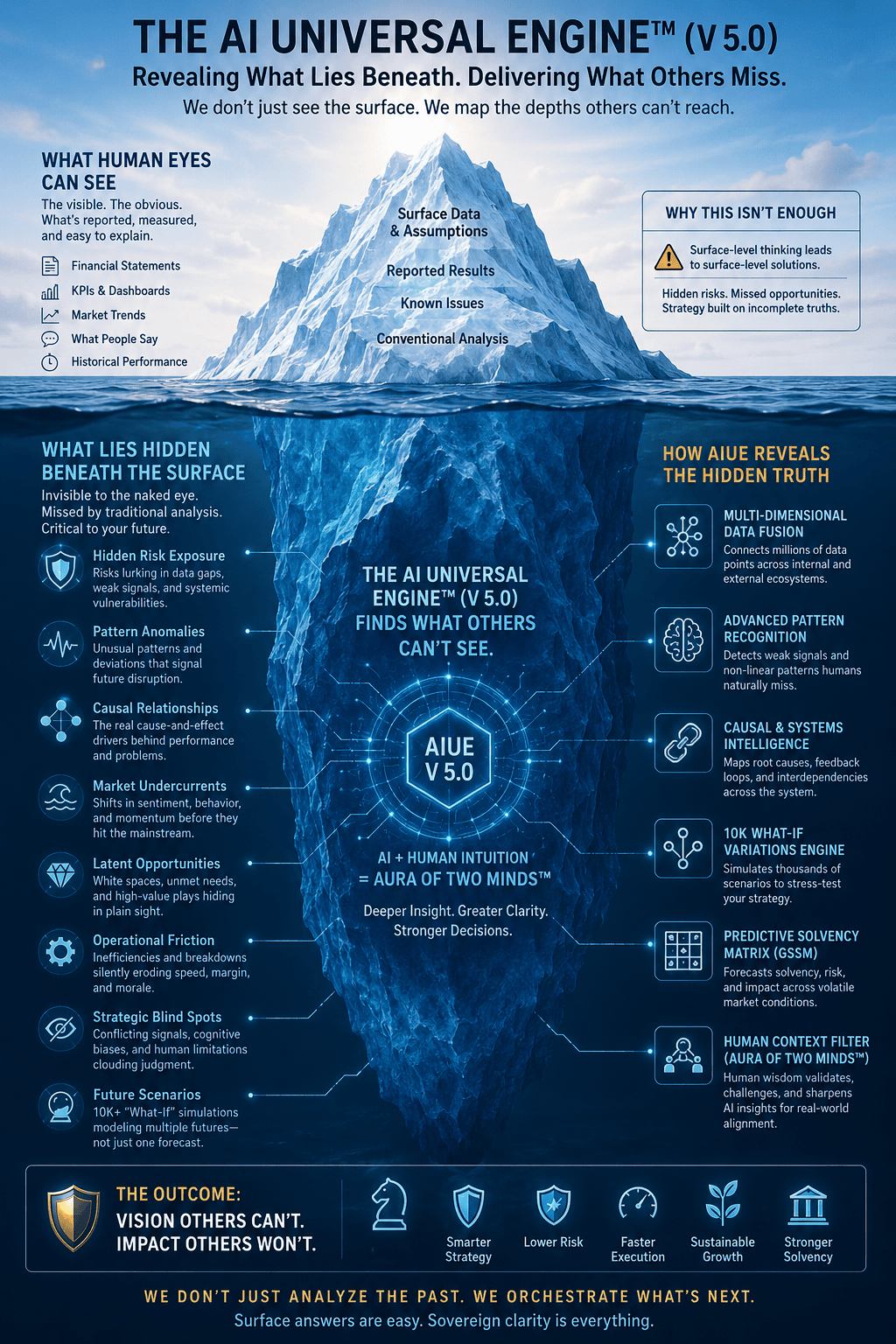
Leadership receives an integrated diagnostic view of the organization that identifies hidden friction, execution gaps, financial and operational vulnerabilities, decision bottlenecks, misaligned resources, and emerging opportunities.
Traditional analytics and consulting assessments frequently examine finance, operations, leadership and workforce conditions separately. This can make cross-functional dependencies and compounding risks difficult to recognize.
AIUE applies an integrated systems perspective to identify relationships among organizational conditions, trace findings to supporting information and show where further investigation may be warranted. Leadership receives an executive-ready diagnostic, prioritized recommendations, documented assumptions and a roadmap for validation and implementation.
Leadership may receive:
a defined decision boundary;
a traceable analytical baseline;
a structured decision package;
prioritized risks and opportunities;
documented assumptions and limitations;
scenario comparisons;
governance conditions and escalation paths, when included;
a controlled test plan;
a governed 30/60/90-day roadmap.
What Evidence Supports the AI Universal Engine™?
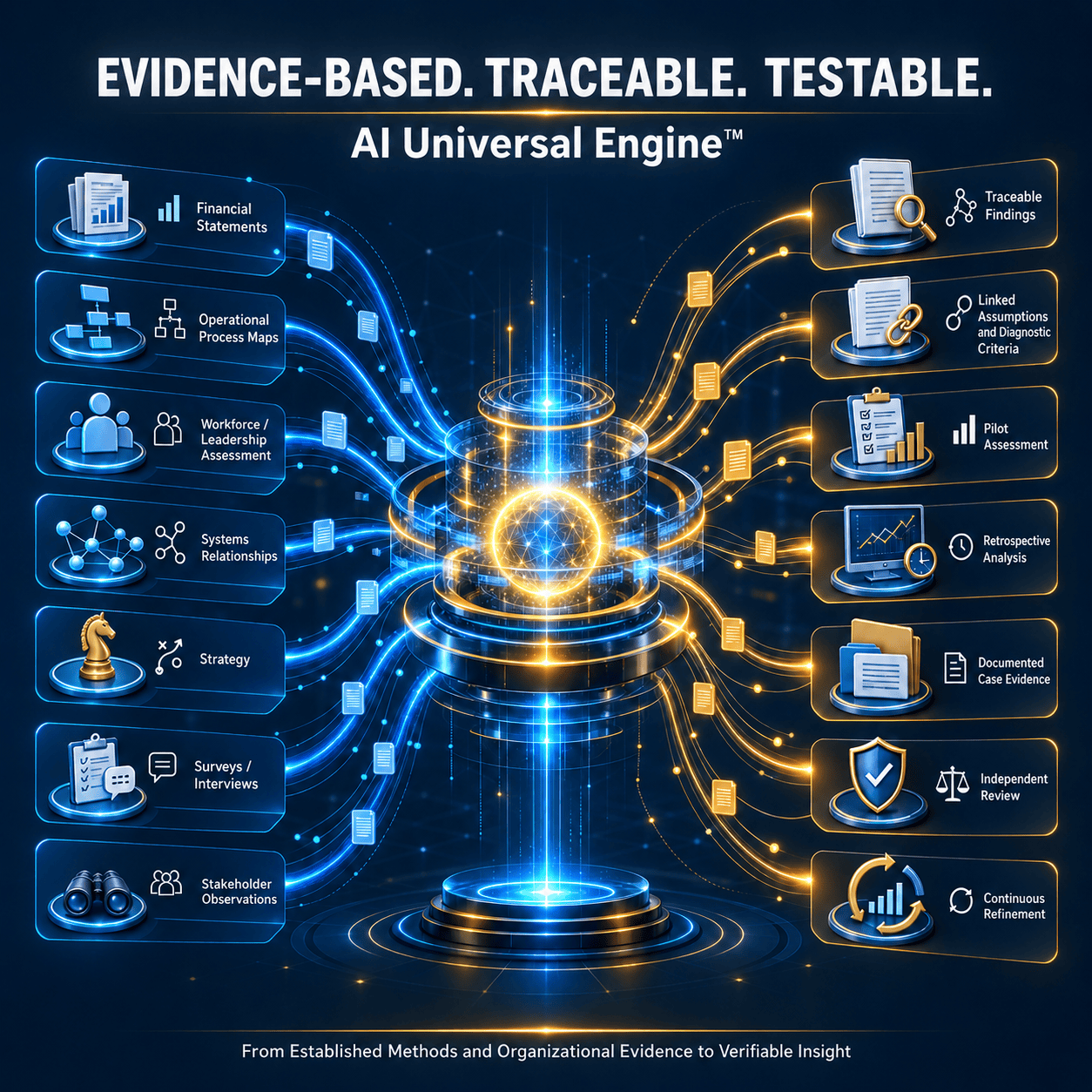
The AI Universal Engine™ draws upon established financial, operational, organizational-development, systems-thinking, and strategic-analysis methodologies.
Findings and performance statements are identified as Illustrative, Projected, Observed or Validated. Targets and simulations are not presented as achieved results. Validation claims are made only when an agreed protocol has been completed and sufficient supporting evidence has been retained.
These include recognized approaches to financial solvency, process evaluation, scenario modeling, leadership assessment, workforce alignment, risk analysis, and organizational performance.
Its conclusions are supported by the organization’s own quantitative and qualitative evidence—such as financial statements, operational records, performance reports, surveys, interviews, process documentation, and stakeholder observations.
Findings can therefore be traced to identifiable inputs, assumptions, relationships, and diagnostic criteria rather than generated as unsupported recommendations.
The AIUE™ is further evaluated through assessments, pilot engagements, retrospective analyses, and documented case studies.
Illustrative simulations are clearly distinguished from verified client results, while measurable outcomes are documented whenever sufficient data and permission are available.
As evidence accumulates, the methodology and its results can be independently reviewed, tested, and refined. Analytical support, governance admissibility and achieved operational outcomes are reported as distinct evidence states.
How Is Organizational Data Protected?
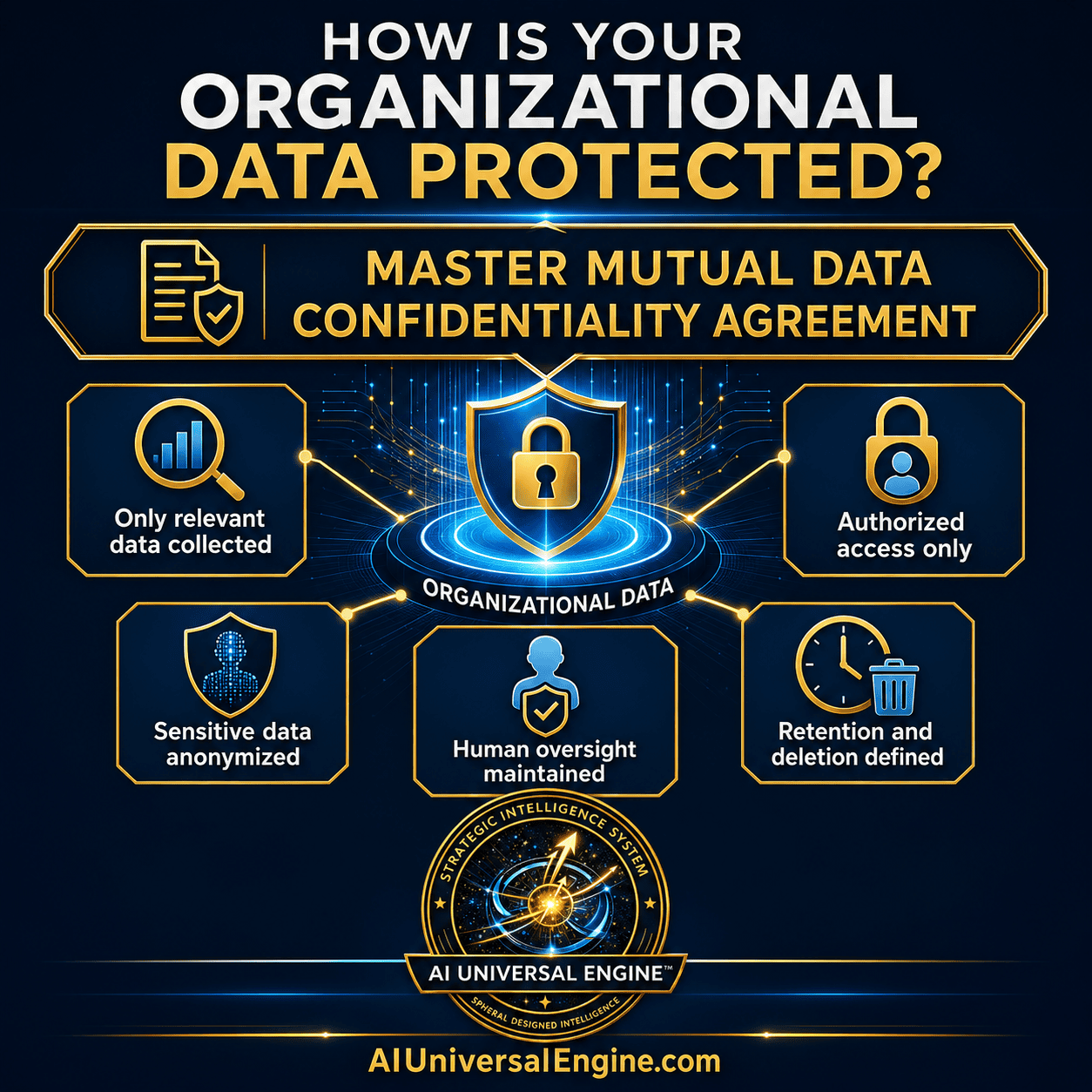
Before analysis begins, the client and AIUE representatives establish the purpose of the engagement, required information, authorized access, permitted use, retention expectations and assessment boundaries through the applicable confidentiality agreement.
Before analysis begins, the organization and AI Universal Engine™ representatives establish what information is needed, how it will be used, who may access it, and the boundaries of the assessment. Governance records may reference evidence sources, policy versions, authority states and decision identifiers without requiring disclosure of proprietary AIUE formulas or analytical code.
This Master Mutual Data Confidentiality and Stress Test Engagement Agreement ("Agreement") is entered into and made effective as of the date of execution, by and between Be The Dream LLC and its designated strategic affiliates (operating under the AI Universal Engine™ architecture, hereinafter referred to as the "Consultant" or "Engine Provider"), and the client enterprise entity executing this instrument (hereinafter referred to as the "Client").
Only information relevant to the agreed analysis should be collected, with access limited to authorized participants.
Findings are presented to designated organizational leaders and are not treated as public information, shared for unrelated purposes, or represented as client case studies without explicit permission.
Because confidentiality needs vary by organization, additional safeguards—including nondisclosure terms, access restrictions, data minimization, retention requirements, and secure disposal—can be defined before sensitive information is transferred.
Organizations should review the published Data Confidentiality Agreement and confirm that its protections satisfy their legal, regulatory, and internal security requirements before proceeding.
Who Created The AI Universal Engine™?
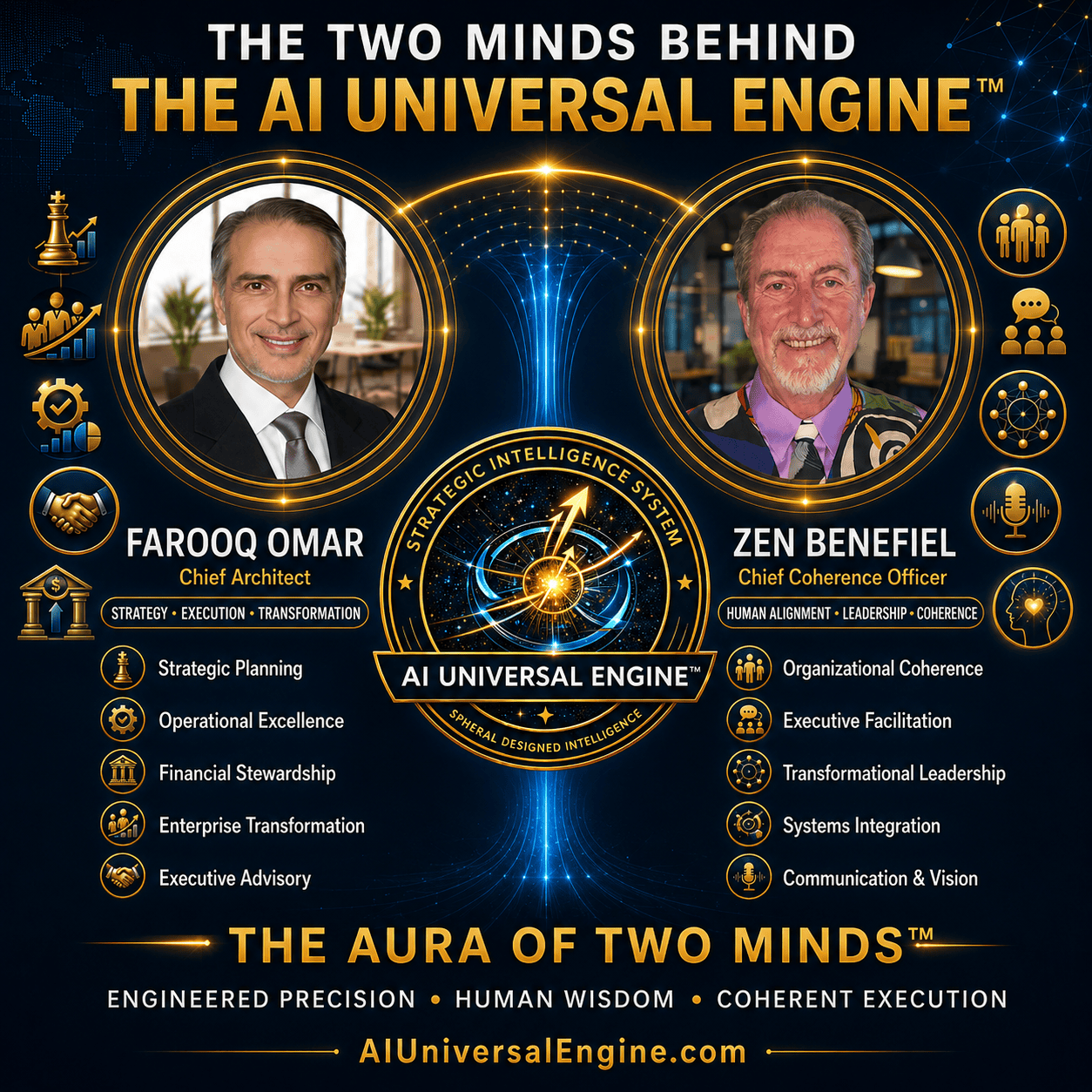
The AI Universal Engine™ was co-created by Farooq Omar and Bruce “Zen” Benefiel through five years of collaborative research, systems analysis, and architectural development.
Farooq Omar serves as the Engine’s principal AI architect, contributing expertise in artificial intelligence, machine learning, financial modeling, and enterprise systems.
His work provides the analytical and technological foundation through which organizational information can be examined, relationships modeled, and strategic alternatives evaluated. The architecture reflects a disciplined effort to move beyond disconnected AI applications toward an integrated system for organizational diagnosis, foresight, and decision support.
Zen Benefiel contributes more than three decades of experience in organizational development, strategic facilitation, leadership alignment, systems thinking, and human transformation.
Their collaboration became the foundation for the Aura of Two Minds™—a partnership that unites machine precision with human wisdom, contextual understanding, ethics, and accountability. Together, they created the AIUE™ to help organizations move from fragmented information and activity toward clearer decisions and more coherent execution..
The AIUE™ therefore reflects more than a technological achievement; it represents the convergence of two complementary disciplines. Its creation demonstrates what becomes possible when advanced analytical architecture is guided by human experience, purpose, and responsibility.
The Core of the AIUE™ Philosophy
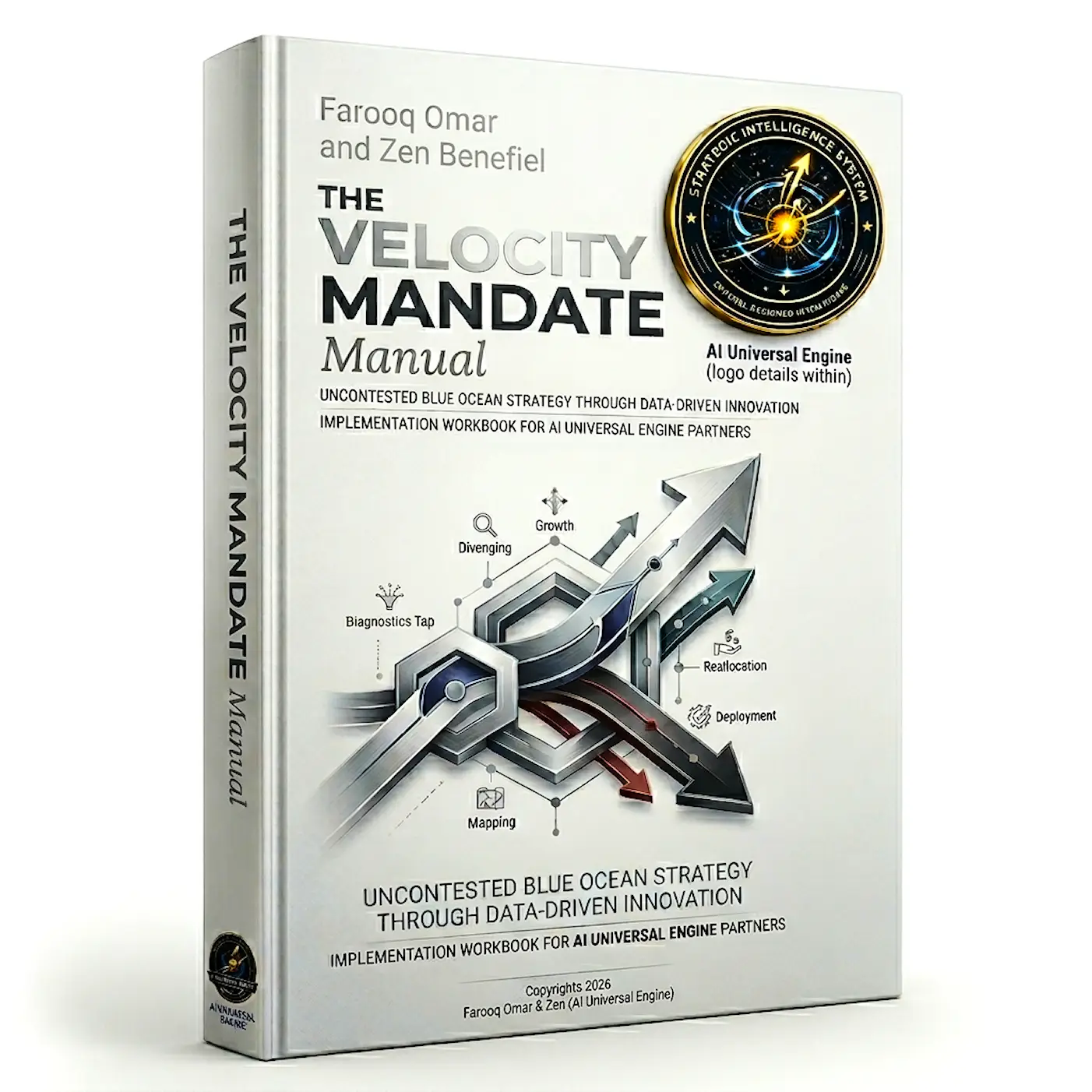
The Forensic Field Manual for High-Velocity Leadership
The Velocity Mandate Manual reveals how organizations can reduce decision latency, expose hidden friction and translate strategic intent into coordinated action.
The Aura of Two Minds explores the complementary partnership of human wisdom and machine intelligence that makes this possible.
Together, they establish the philosophical and operational foundation of Coherent Intelligence™—helping leaders see more clearly, decide responsibly and execute with greater coherence.
Download the books for free by clicking on the images.
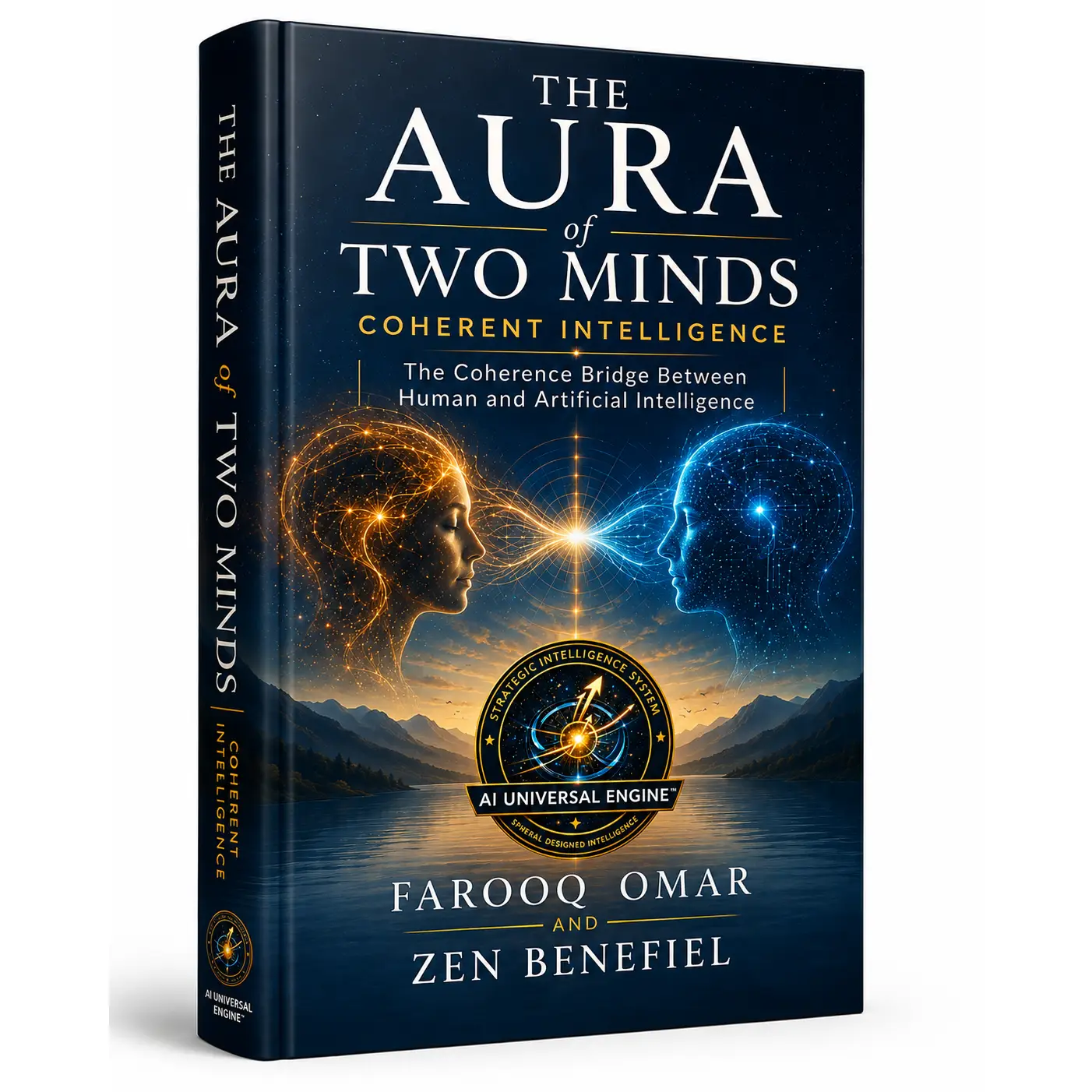
The New Architecture of Leadership, AI, and Coherent Intelligence
What Is The Next Step?
The next step is to experience the AIUE™ through the Sample Dashboard or begin with a confidential Strategic Alignment Assessment. Fill out the form for access.
The initial exploration helps leadership clarify its most pressing challenges and determine where deeper analysis may be valuable. By examining current priorities, performance concerns, decision bottlenecks, and emerging risks, the AIUE™ begins building a more integrated picture of the organization. This starting point allows leaders to experience the Engine’s approach without making a major commitment or undertaking an immediate organization-wide transformation.
Leadership can then review the preliminary findings, refine strategic priorities, and decide whether to pursue a forensic assessment, strategic simulation, pilot initiative, or guided transformation engagement. The appropriate pathway depends on the organization’s needs, available information, urgency, and readiness for change. Each option is intended to deepen understanding while producing practical insights that leadership can evaluate before committing significant time, capital, or organizational resources.
The process begins with curiosity and a willingness to examine what may be hidden beneath visible challenges. From there, the AIUE™ can help leadership create a clearer, more confident path toward alignment, resilience, and coherent execution.
Or, you can schedule a Zoom call here.