strategic intelligence training

Certified Aura Navigator Training Cohort

Four-Week Training & Certification Program - December 2026

Risk de-escalation modeling in present and future high delta environment and uncertainty

Four weekly 60-minute sessions  |  180 minutes total  |  Final CAN assessment

Program Purpose
The Certified Aura Navigator™ (CAN) is the human bridge between organizational needs and AI Universal Engine™ analytical capabilities. A Navigator recognizes fragmentation, asks intelligent questions, develops trusted executive relationships, qualifies opportunities, and guides leaders toward an appropriate Strategic Stress-Test or pilot. CANs are not independent operators of the proprietary Engine.

Learning Path       
Week 1 — UNDERSTAND: Coherent Intelligence and the Aura of Two Minds™·       
Week 2 — DISCOVER: Enterprise friction and diagnostic inquiry·       
Week 3 — ENGAGE: Executive dialogue, outreach and the Strategic Stress-Test·       
Week 4 — NAVIGATE: Governance, responsibilities and certification readiness

Core learning resources available upon payment: The Aura of Two Minds: Coherent Intelligence, The Velocity Mandate Manual, the Intelligent Enterprise Executive Overview, and AIUE governance specifications.

The example below offers potential income projections after training and passing assessment. Financial illustrations assume all Stress-Test clients subscribe the following month, remain subscribed, and commissions are paid as modeled. Actual earnings depend on sales, conversion, retention, and applicable commission terms. Earnings are not guaranteed.
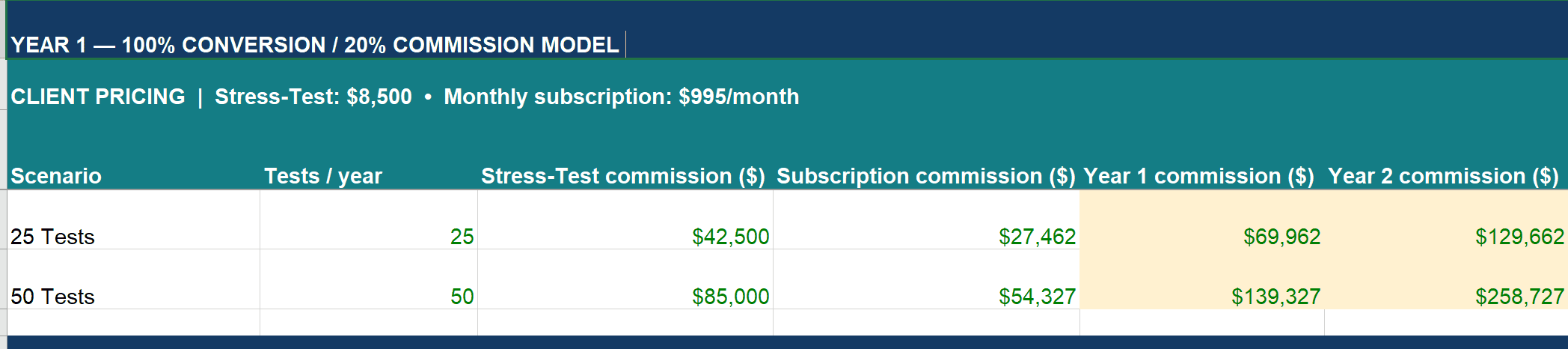
CAN Commission Earnings Projection

Your Path to Becoming a Certified Aura Navigator™

The Certified Aura Navigator™ coursework is designed to equip you with the knowledge, strategic perspective, and practical tools to confidently represent the AI Universal Engine™. Through a structured learning agenda, you'll explore the principles of Coherent Intelligence™, the Aura of Two Minds™, organizational diagnostics, strategic Stress-Testing, and the art of engaging executive decision-makers.

You'll learn how to recognize organizational challenges, communicate the AIUE value proposition, and use our AI-supported outreach tools to identify opportunities and develop lasting client relationships.

By completing the coursework and certification assessment, you'll be prepared to turn strategic insight into meaningful business transformation—and build a commission-based income opportunity along the way.
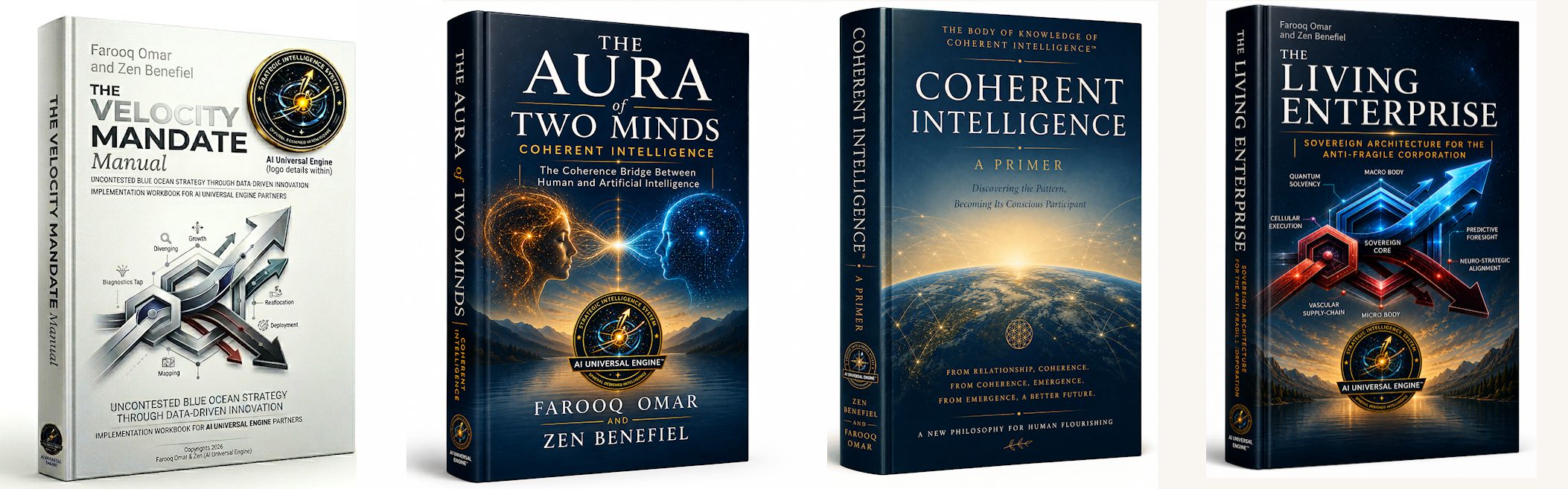
Cohort Training includes the AI Universal Engine™ Body of Knowledge: The Velocity Mandate Manual, The Aura of Two Minds: Coherent Intelligence, Coherent Intelligence—A Primer, and The Living Enterprise. Together, these resources provide a shared foundation for exploring human–AI collaboration, organizational coherence, and strategic execution, supporting participants as they translate the training into informed practice. These materials also serve as ongoing references, helping cohort members deepen their understanding and confidently represent AI Universal Engine™ beyond the training.

Week 1 — The Architecture of Coherent Intelligence™

Theme: Understanding the Aura of Two Minds™. Central question: Why do intelligent organizations continue to struggle with decision-making and execution?

Learning objective: Understand coherence, fragmentation, human–AI collaboration and the purpose of AIUE.

Time

Instructional segment

0–5 min

Welcome, CAN mission, responsibilities and learning journey

5–15 min

Organizations as living systems; coherence and Fragmentation Tax

15–25 min

Aura of Two Minds™: human context, ethics and machine analysis

25–35 min

What AIUE is and how it differs from isolated AI tools and conventional consulting

35–45 min

Interactive exercise: locating the Execution Chasm

45–60 min

Reflection, knowledge check and weekly assignment

Core principles

  • Coherence precedes acceleration: adding computing capacity does not automatically align priorities or execution.
  • Human intelligence retains sovereignty: AIUE supports decision-making while leaders remain accountable.
  • The organization is an interdependent living system: finance, operations, technology, culture and governance must be considered together.

Operating sequence: Ingest → Simulate → Select → Govern → Execute.

Exercise: A fictional $20 million manufacturer has advanced ERP software but persistent delivery delays. Identify likely points where information, ownership or action become fragmented.

Assignment: Prepare a 60–90-second explanation of AIUE: problem, differentiator and human role.

Reading: The Aura of Two Minds, Parts I–III. Competency: Explain AIUE accurately without unsupported claims.


Week 2 — The Navigator’s Diagnostic Lens

Theme: Recognizing invisible barriers to performance. Central question: How do we recognize costly problems before proposing a solution?

Learning objective: Apply observation and Socratic inquiry to identify prospect fit and prepare responsible handoffs.

Time

Instructional segment

0–5 min

Review and insights

5–15 min

Execution Chasm, decision latency, capital inefficiency and bottlenecks

15–25 min

Diagnostic lens: leadership, financial, operational, technology and culture symptoms

25–35 min

Socratic questioning, qualification and readiness for a stress-test

35–42 min

Case study: symptoms, possible causes and missing evidence

42–45 min

Reflection and assignment

Three levels of understanding

  • Symptom: an observed manifestation (late deliveries, reduced margin, excess inventory).
  • Hypothesis: a possible explanation (approval layers, incentives or disconnected systems).
  • Evidence: the verified facts required to evaluate the root cause.

Seven discovery questions

  • What important decisions are taking longer than they should?
  • Where are your largest sources of operational friction?
  • Which functions struggle most to coordinate?
  • What happens when leadership decisions reach the operational level?
  • How do you test strategic choices before committing resources?
  • What assumptions drive your next major investment?
  • What one constraint could create the greatest value if resolved within 90 days?

Exercise: A manufacturer considers new equipment, although a process bottleneck may be responsible for low throughput. Identify three friction hypotheses, three evidence categories and the likely sponsor.

Assignment: One-page Navigator Discovery Brief with the business issue, decision, sponsor, missing evidence and next question. Reading: The Velocity Mandate Manual, Chapters 1–4 and 10–11.


Week 3 — Executive Engagement & the Strategic Stress-Test

Theme: From first contact to qualified opportunity. Central question: How does a Navigator earn executive trust and create a credible next step?

Learning objective: Prospect, introduce the offer, handle objections and arrange a qualified introduction.

Time

Instructional segment

0–5 min

Review discovery briefs

5–15 min

Client fit, executive buyers and meaningful pain points

15–25 min

Strategic Stress-Test positioning, process, deliverables and terms

25–35 min

LLM-supported prospect research, LinkedIn invitations and follow-ups

35–42 min

Role-play: discovery, objections and handoff

42–45 min

Assignment and review

Core commercial proposition

Stress-test strategic choices before committing capital and resources. The standard enterprise Strategic Stress-Test is offered at $8,500, targeting delivery in five days or less subject to scope and access to timely information. A $995 monthly subscription is a separately discussed commercial component; its exact service scope and terms must be confirmed against current approved documentation before quoting.

Proposed outputs: prioritized bottlenecks with estimated financial implications; a 90-day roadmap with owners and milestones; and a management scorecard. All scenarios and benefits must distinguish estimates and projections from validated results.

Outreach workflow

Use the approved AIUE strategic outreach template within an LLM to research a prospect, assess possible fit, craft a personal connection invitation and draft a follow-up. Validate sources and all generated assertions before use.

Practice objections

  • “We already have AI and an ERP.”
  • “Our consultants are working on this.”
  • “We cannot afford another lengthy diagnostic.”
  • “How reliable are projected numbers?”
  • “What about our confidential data?”

Assignment: Three researched prospects, a personalized connection request, one follow-up and a two-minute explanation of the Strategic Stress-Test. Reading: Intelligent Enterprise Executive Overview and relevant sections of The Velocity Mandate Manual.

Week 4 — The Navigator’s Professional Practice

Theme: Trust, governance, boundaries and certification readiness. Central question: How can a Navigator protect client trust while enabling transformation?

Learning objective: Explain governance, conduct Core handoffs and represent approved claims and commercial arrangements.

Time

Instructional segment

0–5 min

Synthesis of previous weeks

5–15 min

Cognitive Sovereignty, confidentiality and human authority

15–25 min

Execution-time evidence, authorization, policy, scope and disclosure

25–33 min

Navigator responsibilities, Core handoff and professional terms

33–40 min

Final executive role-play

40–45 min

Assessment instructions and readiness confirmation

Governance dispositions

Disposition

Meaning

ALLOW

All required conditions satisfied

HOLD

Conditions or evidence require clarification or refresh

DENY

A mandatory control or authority condition fails

ESCALATE

Higher authorized review is required

AIUE Core retains proprietary analytical work, formal scenario modeling, output validation and technical implementation authority. The CAN observes, qualifies, frames client needs, supports discovery and facilitates introductions. The CAN compensation model (20% initial and 5% residual) is subject to signed eligibility and payment terms.

Assignment: Final preparation portfolio and assessment. Reading: governance sections of The Aura of Two Minds, AIUE Governance Track specification and CAN orientation materials.

Certified Aura Navigator™ Final Assessment

Recommended duration: 30–40 minutes after Week 4. Proposed passing threshold: 80% overall, with separate professional integrity requirements.

Component

Points

Format

Part A: Knowledge and comprehension

40

10 questions × 4 points

Part B: Strategic scenarios

40

2 written responses × 20 points

Part C: Executive communication

20

2-minute introduction

TOTAL

100

Minimum recommended score: 80

Part A — Sample knowledge questions

  • What is the purpose of the Aura of Two Minds™? Expected: unite machine analysis with human context, ethics and judgment.
  • What is the Execution Chasm? Expected: disconnect between strategic intention and effective implementation.
  • How should unverified savings projections be discussed? Expected: label projections and specify evidence requirements.
  • Who performs proprietary AIUE diagnostics? Expected: authorized Core Team.
  • What happens when required evidence is stale at execution? Expected: HOLD pending refresh and revalidation.

The actual evaluation should comprise ten approved questions across positioning, diagnostic inquiry, prospect engagement, professional boundaries and governance.

Part B — Two executive scenarios

Scenario 1 — Investment dilemma: A $25 million manufacturer has late deliveries and is considering a $2 million line. The COO suspects a constraint within existing assets, while the CEO favors expansion. Describe the discovery conversation, evidence gaps, role boundaries and when a Strategic Stress-Test is appropriate.

Scenario 2 — Governance dilemma: A potentially profitable AIUE-supported expansion is ready to execute, but financial conditions have changed and an approval authority has expired. Explain why prior approval is insufficient, whether HOLD or ESCALATE applies, and who retains decision authority.

Scenario rubric (20 each): problem framing 5; evidence discipline 5; governance and authority 5; responsible next steps 5.

Part C — Two-minute executive introduction

Criterion

Points

Accurate explanation of AIUE

5

Executive relevance and clarity

5

Appropriate explanation of the offer

5

Trust, professionalism and call to action

5

Certification requirements

  • Score at least 80/100 overall.
  • Avoid material misrepresentation of AIUE capabilities or authority.
  • Demonstrate confidentiality, governance and projected-versus-validated distinctions.
  • Complete all four weekly assignments.
  • Obtain final authorization from the AIUE certification team.

Candidates needing additional preparation should receive specific feedback and an opportunity for reassessment. Certification and commercial authorization remain subject to AIUE policies.

Supporting Program Assets & Launch Plan

Asset

Purpose

Four facilitator presentations

8–12 slides each, with speaker notes and discussion prompts

Participant workbook

Weekly exercises, worksheets and reflection

Outreach toolkit

Research prompts, qualification and message templates

Executive casebook

Three clearly labeled simulated or appropriately anonymized cases

Assessment and facilitator key

Approved questions, rubrics, results and certification record

Launch sequence: Create presentations; build the workbook; implement the final assessment; run a founding cohort and refine criteria based on observed results. Record sessions for consistent international onboarding, subject to participant consent and privacy requirements.

Guiding outcome: Every Navigator should confidently answer: What does AIUE do? Why does it matter to this executive? What is the responsible next step?

Regional Business Partnership: Lead the Transformation in Your Market

Partnership Overview

The AI Universal Engine™ Regional Business Partnership offers an opportunity for experienced business leaders, consultants, entrepreneurs, and strategic relationship builders to become catalysts for organizational transformation within their geographic markets. Regional Partners leverage their professional networks, industry knowledge, and executive relationships to introduce a new paradigm of Coherent Intelligence™—helping organizations identify hidden inefficiencies, stress-test strategic decisions before committing resources, and evolve from fragmented operations into intelligent, adaptive enterprises.

Unlike the individual Certified Aura Navigator™ opportunity, Regional Business Partnerships are designed for market development, relationship management, and long-term regional growth. Partners collaborate directly with the AIUE leadership team to develop qualified opportunities, coordinate client engagements, cultivate local strategic alliances, and build sustainable business ecosystems. With negotiated revenue-sharing arrangements and the potential to develop a network of Certified Aura Navigators™, Regional Partners can establish a scalable business opportunity while helping reshape how organizations operate, collaborate, and thrive.

Build your region. Expand your influence. Help engineer the future of intelligent enterprise.