What becomes possible when the Chief Human Resource Officer stops managing people as resources and starts cultivating the coherence that allows human potential to thrive?
The Remarkable Coherent Chief Human Resource Officer
Cultivating Human Potential in the Age of Intelligent Systems
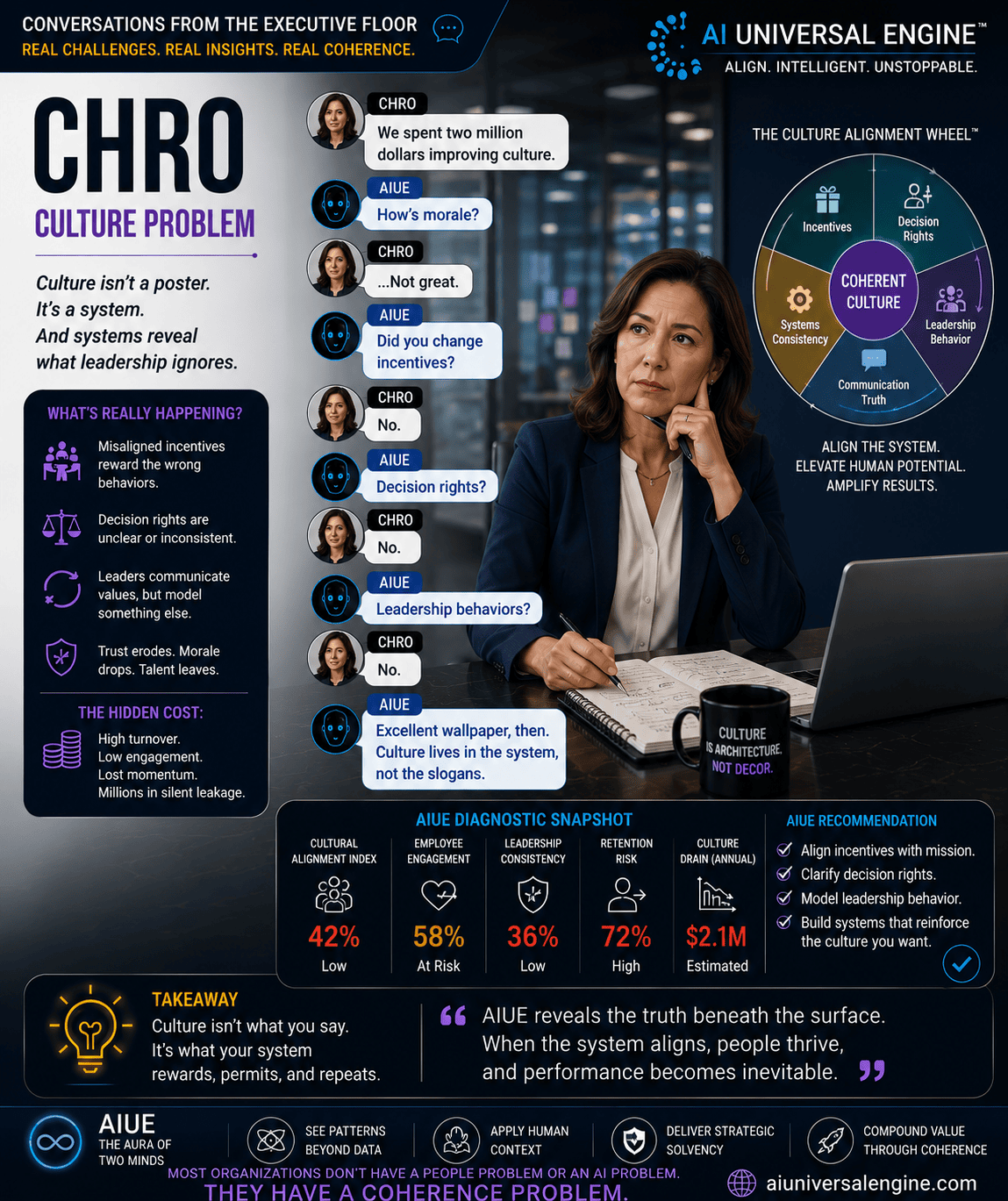
Artificial intelligence is rapidly changing what organizations can know, predict, automate, and optimize.
Yet the greatest challenge facing organizations may not be artificial intelligence at all.
It may be human coherence.As intelligent systems become increasingly capable, the role of the Chief Human Resources Officer is evolving with them.
The CHRO can no longer be primarily the steward of policies, talent acquisition, benefits, compliance, and performance systems. Those functions remain necessary, but they are no longer sufficient.
The emerging CHRO must become an architect of organizational coherence.
The question is shifting from:
How do we manage our people effectively?
to:
How do we create the conditions in which people, purpose, intelligence, and execution naturally align?
That is a very different mandate.
The Paradox of Intelligent Organizations
Organizations now possess extraordinary technological capabilities. Leaders have access to more data, analytics, predictive tools, dashboards, communication platforms, and artificial intelligence than any generation before them.Yet many organizations remain remarkably fragmented.
Employees are overwhelmed.
Departments operate in silos.
Meetings multiply.
Trust declines.
Strategy becomes disconnected from daily activity.
People struggle to understand how their work contributes to the larger purpose.
And increasingly sophisticated technology is layered onto organizations that have never resolved the human problems underneath them.
AI can accelerate information processing.
It can identify patterns.
It can automate workflows.
It can model scenarios.
It can help leaders see relationships within enormous quantities of organizational data.
But AI cannot manufacture trust.It cannot create genuine belonging.It cannot determine what people should care about.It cannot reconcile competing values without human judgment.
And it cannot create coherence inside an organization whose people are fundamentally misaligned.
Technology amplifies the system into which it is introduced.If the organization is coherent, technology can amplify coherence.If the organization is fragmented, technology may simply help fragmentation move faster.
This is a complex problem to solve for the Chief Human Resource Officer.
From Human Resources to Human Potential
The phrase human resources carries an industrial-age assumption: people are resources to be allocated, managed, measured, and optimized.But people are not components in a machine.
They are adaptive, relational, meaning-making participants within a living organizational system.
They bring experience, intuition, creativity, emotion, judgment, relationships, aspirations, and values into the workplace every day.
When those dimensions are ignored, organizations pay a hidden price.
Disengagement increases.Innovation slows.
Communication becomes guarded.
Employees protect themselves rather than contribute openly.
Managers spend increasing amounts of time resolving misunderstandings that should never have become conflicts.
Policies multiply because trust declines.
The organization develops what might be called a fragmentation tax: the cumulative cost created by misalignment among people, processes, priorities, and purpose.
The coherent CHRO recognizes that cultivating human potential is not simply an employee benefit.It is an operational imperative.
Culture Is Not What the Organization Says
Most organizations have values.
Many display them prominently.
Integrity.
Innovation.
Collaboration.
Respect.
Excellence.
The difficulty is rarely defining the values.
The difficulty is discovering whether the organization actually behaves according to them.
Culture exists in the gap between stated values and lived experience.
Employees discover the real culture when they raise an uncomfortable concern.
They discover it when a project fails.
They discover it when departments disagree.
They discover it when a leader makes a mistake.
They discover it when short-term financial pressure collides with a stated commitment to people.
These moments reveal the organization's true operating system.
The coherent Chief Human Resource Officer therefore asks deeper questions.
Where does trust break down?
Where does information stop flowing?
Where are employees afraid to speak candidly?
Where are incentives encouraging behaviors that contradict stated values?
Where are responsibilities unclear?
Where do competing priorities create unnecessary friction?
These are not merely HR questions.
They are questions about organizational intelligence.
Coherence Is Not Conformity
A coherent organization is not one in which everyone agrees.
Agreement can actually hide dysfunction.
People may remain silent because disagreement carries social or professional risk.
Coherence means something different.
It means people can disagree while remaining aligned around shared purpose.
Different perspectives become useful information rather than threats.
Healthy tension becomes a source of learning.
Conflict becomes something to navigate rather than suppress.
The goal is not uniform thinking.
It is aligned diversity.
That distinction will become increasingly important as organizations integrate AI into decision-making. Machines can rapidly generate possibilities, but humans must still determine which possibilities are appropriate, ethical, meaningful, and consistent with organizational purpose.
The organization therefore needs both intelligent systems and intelligent relationships.
The Chief Human Resource Officer as Organizational Sensor
HR occupies a unique position.
It touches virtually every part of the enterprise.
Recruitment reveals what talent expects.
Onboarding reveals whether organizational promises match reality.
Performance management reveals whether expectations are clear.
Employee relations reveal where trust is deteriorating.
Turnover reveals where the system is failing to retain commitment.
Leadership development reveals whether managers can translate strategy into human behavior.
Engagement data reveals where energy is rising or falling.
Traditionally, these functions have often been treated separately.
The coherent Chief Human Resource Officer begins connecting them.
Instead of seeing isolated HR metrics, the CHRO begins looking for patterns across the human system.
What happens to retention when managers receive better developmental support?
What happens to innovation when psychological safety increases?
What happens to execution when teams gain greater clarity about decision authority?
What happens to productivity when unnecessary approvals disappear?
What happens to engagement when employees can see how their work contributes to organizational purpose?
This is where HR becomes far more strategically powerful.It stops merely reporting what happened.
It begins helping the organization understand why patterns are emerging.
Where AI Becomes Useful
AI can dramatically increase the Chief Human Resource Officer's ability to recognize those patterns.
Used thoughtfully, intelligent systems can help identify emerging workforce risks, recurring communication breakdowns, skills gaps, workflow bottlenecks, sentiment changes, and relationships among variables that humans may overlook.
But probabilistic AI has an important limitation.
It generates likely interpretations based on patterns.
Likelihood is not the same as organizational truth.
Human systems contain context that cannot always be inferred from data alone.
A declining engagement score might indicate poor leadership.
Or organizational fatigue.
Or uncertainty about restructuring.
Or frustration with technology.
Or dissatisfaction with compensation.
Or simply a badly designed survey.
The numbers cannot interpret themselves.
This is why the future of organizational intelligence should not be framed as AI versus humans.
The more useful architecture is:
AI precision + human wisdom.
Machines help reveal patterns.
Humans interpret meaning.
Machines expand possibilities.
Humans evaluate consequences.
Machines increase analytical capacity.
Humans remain responsible for purpose, judgment, ethics, relationships, and action.
From Engagement to Alignment
For years, organizations have invested heavily in employee engagement.
Engagement matters, but engagement alone does not guarantee performance.
An employee can be highly engaged in work that is poorly aligned with organizational priorities.
A team can be enthusiastic while duplicating another department's effort.
A leader can be deeply committed while pursuing a strategy that conflicts with another executive's objectives.
The deeper question is therefore not simply:
Are our people engaged?
It is:
Are our people aligned?
Alignment connects purpose, priorities, roles, relationships, decisions, and execution.
When those elements reinforce one another, organizations move with far less friction.
When they conflict, even talented and motivated people struggle.
This suggests an important evolution for HR measurement.
Beyond measuring satisfaction and engagement, organizations need better ways of understanding coherence.
Where are purpose and behavior aligned?
Where are leadership messages contradicting operational realities?
Where are teams working at cross-purposes?
Where is decision-making authority unclear?
Where are employees experiencing friction that leadership cannot see?
These questions transform HR analytics from reporting tools into organizational navigation systems.
The Coherent Chief Human Resource Officer's Emerging Mandate
The next generation of Chief Human Resource Officer leadership may be defined less by managing the workforce and more by cultivating the conditions in which human and artificial intelligence can work together effectively.
That means designing environments where people can speak honestly.
Where disagreement produces learning.
Where technology supports rather than diminishes human agency.
Where leaders listen before deciding.
Where organizational purpose is connected to daily behavior.Where performance problems are examined systemically rather than automatically blamed on individuals.
Where data informs judgment without replacing it.
And where employees are treated not as resources to consume, but as participants in a shared enterprise.
This requires HR to move upstream.Instead of repairing the human consequences of organizational decisions, the CHRO becomes increasingly involved in designing the conditions under which those decisions are made.
That is a significant elevation of the role.
The Human Advantage
The rise of artificial intelligence presents an intriguing paradox.
The more capable machines become, the more valuable distinctly human capabilities may become.
Discernment.
Empathy.
Curiosity.
Courage.
Context.Imagination.
Ethical judgment.
Relationship.
Meaning-making.
The ability to sit across from another human being, recognize a different perspective, and discover a way forward together.
Those capabilities are difficult to capture on a dashboard, yet they often determine whether strategy succeeds.
The coherent Chief Human Resource Officer understands this.
The objective is not to make humans behave more like machines.
It is to allow machines to do what machines do exceptionally well while developing humans to do what humans uniquely contribute.
A New Question for HR Leadership
For decades, HR has asked how organizations can attract, develop, engage, and retain the best people.
Those questions remain important.But another question is emerging beneath them:
What kind of organizational environment allows intelligence—human and artificial—to become coherent enough to produce wise action?
That may become one of the defining leadership questions of the next decade.
Because the future will not belong simply to organizations with the most advanced AI.
Nor necessarily to those with the largest workforce, the most data, or the greatest technological investment.
It may belong to organizations capable of bringing people, purpose, intelligence, and action into alignment.
And few executives are better positioned to lead that transformation than the Chief Human Resource Officer.
The evolution from Human Resources to human potential has already begun.
The opportunity now is to move from managing people to cultivating coherence—and from measuring the workforce to understanding the living system those people create together.
If your excited about the opportunities present with the AI Universal Engine™, reach out to our organizational development partner, Be The Dream. A fitting name for a lifestyle.
If you'd like to expand your career and become a Certified Aura Navigator and represent the AIUE™ to other organizations, visit our certification page.