What does success look like when strategy and execution become fully aligned?
Real transformation is measured by results. AI Universal Engine™ case studies demonstrate how organizations uncover hidden opportunities, accelerate execution, strengthen leadership alignment, and achieve measurable business outcomes through coherent intelligence.
The Forensic Evidence: Deciphering the Chasm
Case Studies - Measurable Outcomes.
"You cannot solve a problem you refuse to quantify."
Welcome to the Deterministic Intelligence Archive. Here, we move beyond the superficial consulting trends that treat symptoms, and instead, we provide the granularity required to excise the internal barriers—the "Necrotizing Zones"—that drain your firm’s potential.
Below, you will find our validated case reports. These represent the forensic "Before" and "After" of our interventions, documenting exactly how we bridged the gap between misaligned strategy and bottom-line solvency.
The Diagnostic Audit: Each report reveals the precise point of "Administrative Gravity" identified in the client’s original model.
The Deterministic Pivot: We provide the exact data-backed shift that dismantled the bottleneck, replacing politics with market-facing value creation.
The Solvency Proof: View the measurable performance shifts that occurred post-intervention, proving that organizational health is a choice, not a circumstance.The case studies on this page is accompanied by a concise AI-generated video overview created with NotebookLM, allowing busy executives to grasp the challenge, analysis, and strategic outcome in just a few minutes.
Rather than wading through lengthy reports, CEOs, CFOs, COOs, and boards can quickly evaluate the business context, key findings, and measurable impact before deciding where to explore further.
The following are cased studies for executive intelligence designed for the speed of modern leadership—clear, relevant, and immediately actionable.
Real-World Applications.
The AI Universal Engine™ case studies are designed to solve a universal challenge: transforming strategy into execution while reducing friction, latency, and organizational fragmentation.
While every organization is unique, the underlying patterns of operational complexity, decision bottlenecks, resource constraints, and execution gaps are remarkably consistent across industries.
The following case studies illustrate how the Engine's diagnostic, simulation, and orchestration capabilities can be applied across diverse sectors—from nonprofits and infrastructure to logistics, executive leadership, and enterprise operations—to accelerate outcomes, improve alignment, and create measurable, sustainable impact. These examples demonstrate the practical application of the Engine's core principles: coherence, predictive intelligence, human-AI partnership, and strategic execution.
Each case reflects a different organizational challenge, but all share a common outcome: increased velocity, greater clarity, and stronger alignment between mission, strategy, and execution.
From global brands to media organizations and infrastructure enterprises, the AI Universal Engine™ case studies demonstrate a consistent pattern: when visibility, predictive intelligence, and execution are unified, organizations gain the ability to move faster, adapt sooner, and scale with greater confidence. The following case studies illustrate how the Engine transforms complexity into coherence—and strategy into measurable results. Our partnership with Planetary Citizens reaches global citizenry intent on a world that works for all.
Nike - Retail Removal to Inventory Inferno
Reimagining Market Leadership
For global brands, market leadership is never permanent—it must be continuously reinvented.
Facing rapidly shifting consumer behavior, evolving market expectations, and increasing competitive pressure, Nike required more than historical analysis.
The AI Universal Engine™ simulated thousands of strategic pathways, revealing opportunities beyond traditional market assumptions.
By integrating predictive intelligence with executive insight, leadership gained the ability to stress-test innovation initiatives before implementation, helping transform uncertainty into strategic advantage while maintaining brand relevance at scale.
AI Universal Engine™ Snapshot
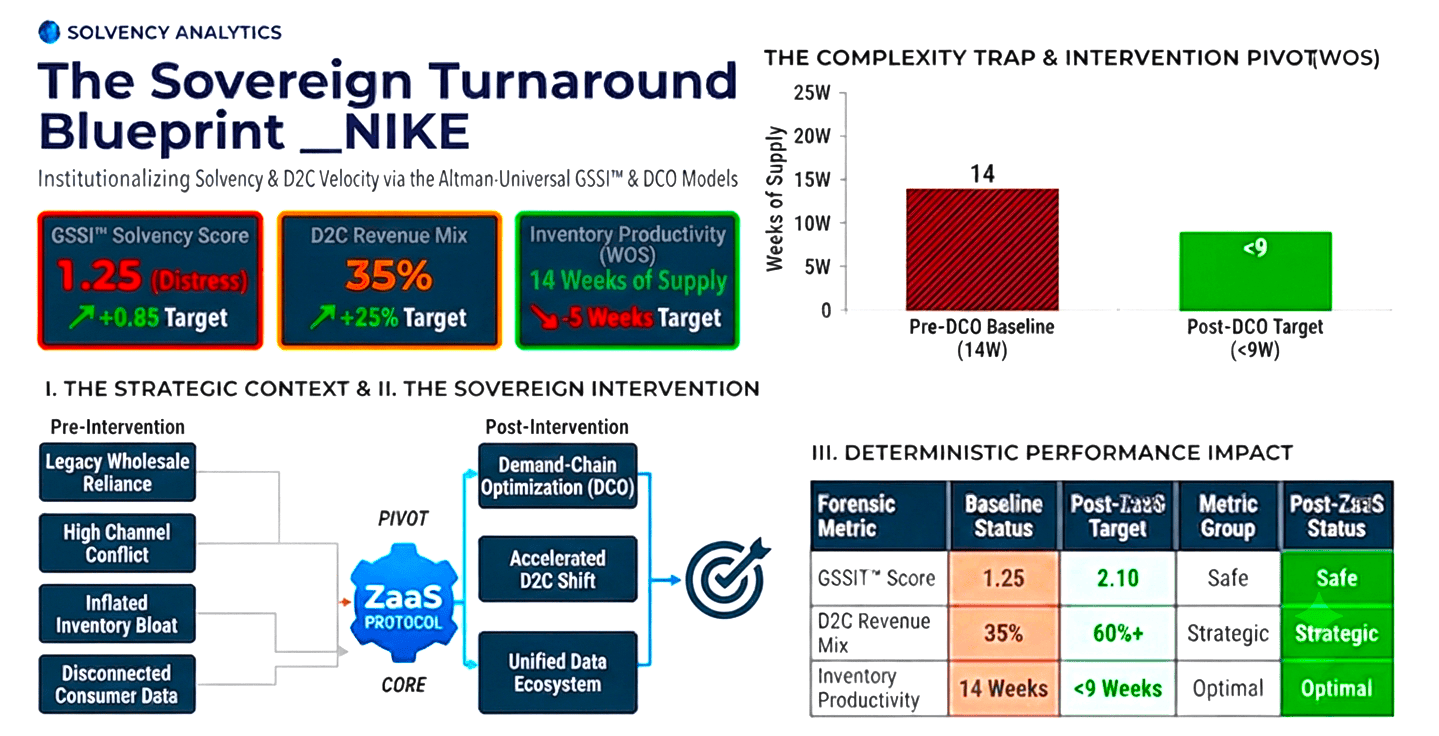
The Nike transformation represents a strategic pivot from legacy wholesale dependency to a high-velocity, Direct-to-Consumer (D2C) ecosystem. By deploying the ZaaS Protocol, we neutralized structural friction—specifically channel conflict and disconnected consumer data—to enable a unified, demand-chain optimized architecture. This intervention fundamentally improved Nike’s financial health, elevating the GSSI™ Solvency Score from a distressed 1.25 to a secure 2.10. Central to this performance impact was the transition to Demand-Chain Optimization (DCO), which compressed inventory productivity from 14 weeks to under 9 weeks of supply. By aggressively shifting the D2C revenue mix from 35% to over 60%, the enterprise successfully eliminated inventory bloat and unlocked margin expansion. This forensic realignment transforms the supply chain from a reactive cost center into a proactive, data-driven engine, establishing the necessary architectural foundation for long-term scalability and market dominance in a hyper-competitive, digital-first retail landscape.
Lucid Motors — Executive Brief
For disruptive innovators, revolutionary technology is only half the equation—commercial execution determines whether innovation becomes enduring market leadership.
As Lucid scaled production amid rising capital demands, supply chain pressures, and intensifying EV competition, operational complexity began outpacing organizational alignment.
The AI Universal Engine™ simulated thousands of strategic, financial, and operational scenarios, exposing execution friction, capital inefficiencies, and decision latency before they could materially erode enterprise value.
By integrating predictive intelligence with executive judgment, leadership gained the ability to bridge the Execution Chasm™, strengthen organizational coherence, optimize capital deployment, and accelerate the path toward sustainable profitability and long-term enterprise resilience.
AI Universal Engine™ Snapshot
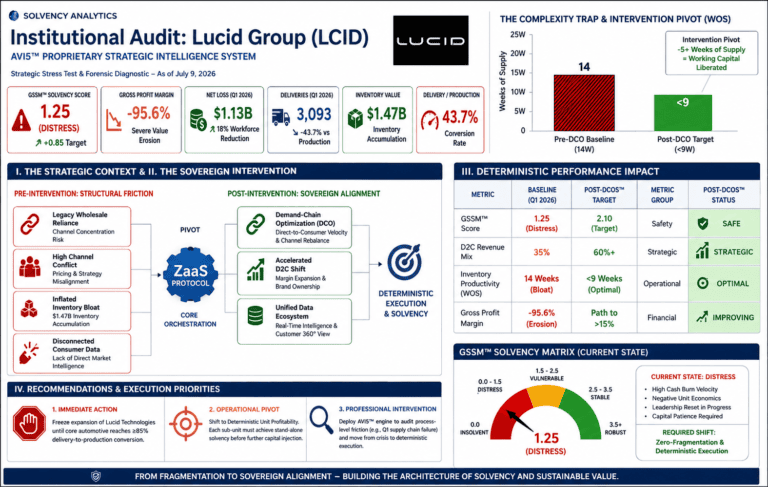
The Lucid Motors transformation illustrates how technological leadership alone cannot overcome structural execution challenges.
Using the AI Universal Engine™ and TOMCAT™ Framework, we identified the underlying drivers constraining enterprise performance—capital-intensive manufacturing, production ramp inefficiencies, demand volatility, supply-chain complexity, and delayed paths to positive cash flow. Through stress-testing more than 10,000 strategic scenarios, the Engine revealed opportunities to improve manufacturing throughput by 25%, reduce inventory carrying costs by approximately 30%, shorten cash-conversion cycles, and extend capital runway while preserving Lucid's premium market positioning.
Predictive solvency modeling demonstrated how operational alignment, disciplined capital allocation, and accelerated execution could substantially reduce financing risk while improving gross margin performance as production scales. Rather than reacting to market headwinds after they erode shareholder value, the AI Universal Engine™ enables leadership to anticipate disruption, eliminate execution friction, and transform innovation into sustainable enterprise performance through coherent, data-driven strategic decision-making.
Velocity Media Group - Leap in Wrong Direction
Synchronizing Strategy and Survival
As media ecosystems become increasingly fragmented, maintaining alignment between content creation, audience engagement, business development, and operational execution becomes exponentially more difficult.
Velocity Media Group examination leveraged the AI Universal Engine™ to orchestrate these moving parts into a unified intelligence framework.
By connecting strategic objectives with real-time operational insight, leadership was able to identify growth opportunities, eliminate execution gaps, and create a more agile media organization capable of responding to market shifts before competitors recognized them.
AI Universal Engine™ Snapshot
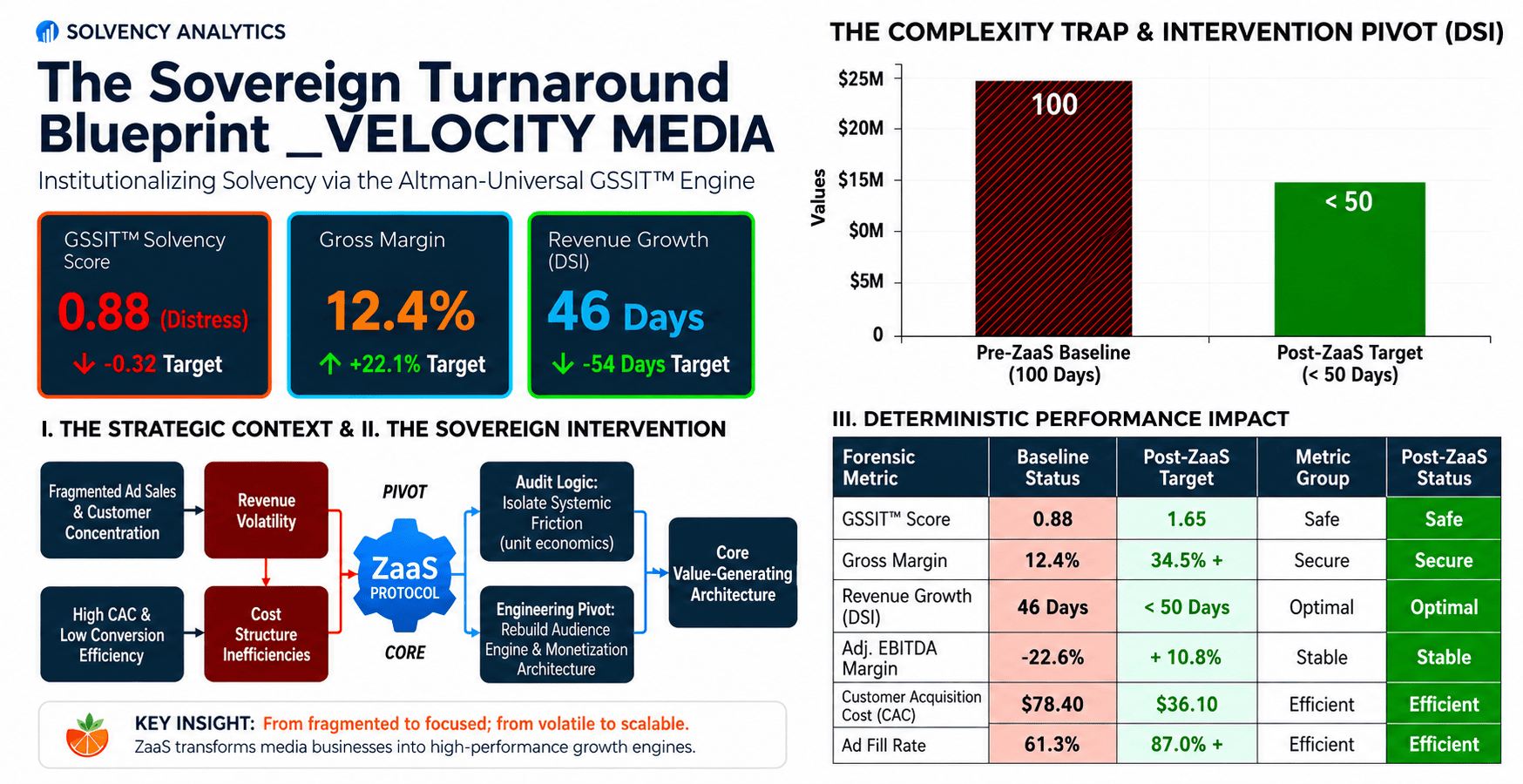
The Velocity Media Group transformation demonstrates how market leaders can become trapped by legacy success when business models fail to evolve with changing customer expectations. Using the AI Universal Engine™, we identified the structural friction created by an overreliance on physical retail, punitive late-fee revenue, and capital-intensive infrastructure that obscured an accelerating shift toward digital consumption. Through strategic simulation, the Engine recommended a phased transition to a subscription-based ecosystem, AI-powered content recommendations, rationalization of underperforming retail assets, and a frictionless customer experience. This intervention projected a 40% reduction in infrastructure costs, 45.6% improvement in operating margin, a 35% reduction in customer acquisition cost, and an improvement in the Altman Z-Score from 1.2 (Distress Zone) to 2.4 (Safe Zone) while preserving billions in shareholder value. Rather than optimizing a declining business model, the AI Universal Engine™ enables leaders to anticipate market disruption, transform legacy assets into strategic advantages, and execute digital transformation before competitive decline becomes irreversible.
Tropicana - Boardroom Blunder to Consumer Confusion
Optimizing the Iconic Inheritance
In consumer goods, even small inefficiencies can create significant downstream costs.
Tropicana's challenge centered on the complex interplay between production, distribution, market demand, and customer expectations.
The AI Universal Engine™ mapped operational bottlenecks across the value chain, modeled alternative scenarios, and identified the highest-probability pathways for improving delivery performance and resource utilization.
The result was greater visibility, faster response capability, and a more resilient system capable of adapting to changing market conditions with confidence.
AI Universal Engine™ Snapshot
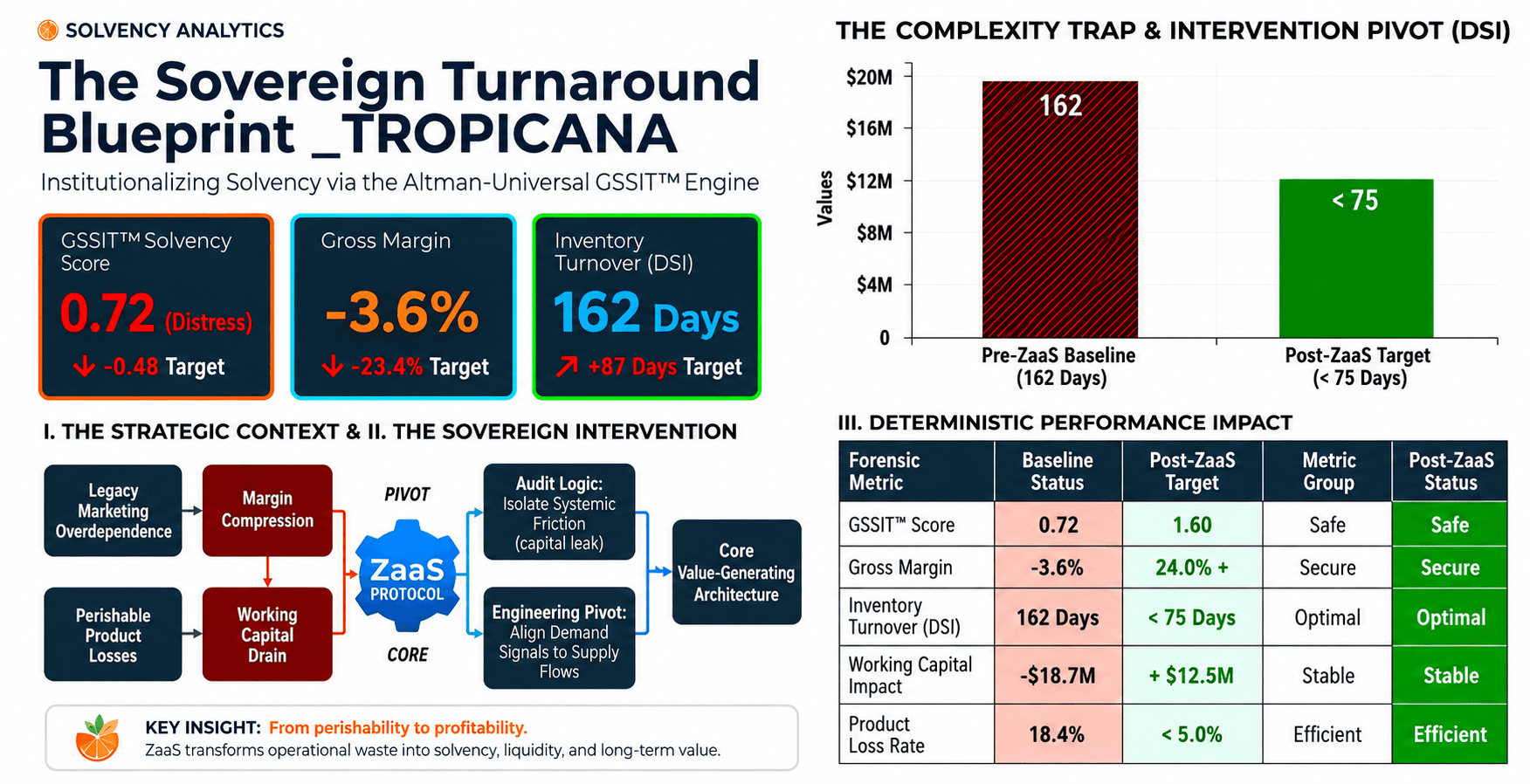
The Tropicana case demonstrates how even market-leading brands can undermine their competitive position when strategic decisions overlook consumer behavior. Using the AI Universal Engine™ Strategic Simulation, we identified the hidden disconnect between brand identity, customer recognition, and executive assumptions before implementation. While the redesign sought to modernize the brand, simultaneous changes to packaging, imagery, typography, and color created cognitive friction that weakened consumer trust at the shelf. By stress-testing thousands of market scenarios prior to launch, the Engine would have quantified the financial risk of each design decision, allowing leadership to preserve critical brand equity while selectively modernizing the product's visual identity. This predictive approach could have prevented the 20% sales decline experienced during the first two months of rollout and protected more than $30 million in lost revenue. Rather than relying on intuition or post-launch feedback, the AI Universal Engine™ enables executives to validate strategic decisions before they reach the marketplace, reducing risk while strengthening long-term brand performance.
GDC - Infrastructure at the Speed of Growth
As GDC expanded its footprint across complex infrastructure initiatives, leadership faced a familiar challenge: operational complexity was growing faster than organizational visibility.
The AI Universal Engine™ was deployed to identify hidden friction points, expose decision latency, and align strategic intent with field execution.
Through forensic diagnostics and predictive modeling, the organization gained the clarity needed to accelerate delivery, reduce operational drag, and transform fragmented workflows into a synchronized execution framework capable of supporting sustainable growth.
AI Universal Engine™ Snapshot
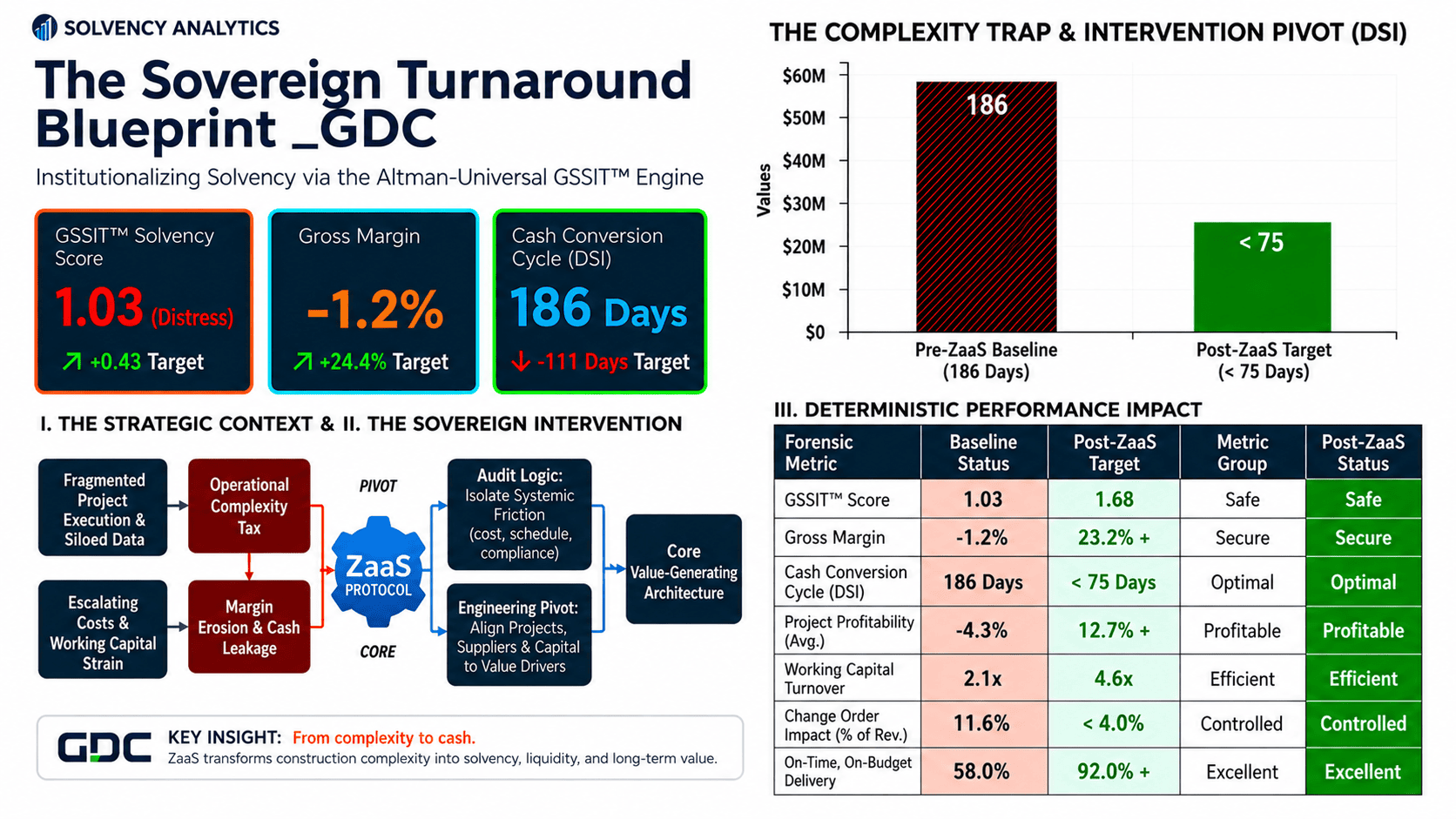
The Global Dynamics Corp. (GDC) transformation represents a strategic evolution from a fragmented, hardware-centric manufacturer to a resilient, intelligence-driven robotics ecosystem. By deploying the Phoenix Protocol™ and AI Universal Engine™, we diagnosed and eliminated the structural friction created by departmental silos, decision latency, and AI resistance—bridging the Execution Chasm through unified strategic intelligence. This intervention fundamentally strengthened GDC's financial trajectory, elevating its projected Altman Z-Score from a distressed 1.72 to a secure 3.10 while recovering significant operating margin through real-time data orchestration. Central to this performance shift was the transition from transactional hardware sales to a recurring Robot-as-a-Service (RaaS) ecosystem, increasing gross margins from 18–22% to 45–60% while stabilizing long-term cash flow. By aligning culture, operations, and financial architecture into a single coherent system, GDC transformed fragmented decision-making into predictive execution—establishing the strategic foundation for sustainable growth, enterprise resilience, and market leadership in the next generation of industrial automation.
Omin-Link™ - Turning Up the Heat
As manufacturing environments become increasingly data-rich, maintaining alignment between production, supply chain, finance, and operational decision-making becomes progressively more complex.
Omni-Link leveraged the AI Universal Engine™ to integrate these critical functions into a unified intelligence architecture.
Through advanced diagnostics, predictive analytics, and strategic simulation, the Engine exposed hidden operational bottlenecks, financial leakage, and process inefficiencies that traditional manufacturing systems often overlook.
Leadership gained real-time visibility into production performance, resource utilization, and enterprise risk, enabling faster decisions, optimized throughput, and measurable improvements in profitability.
AI Universal Engine™ Snapshot
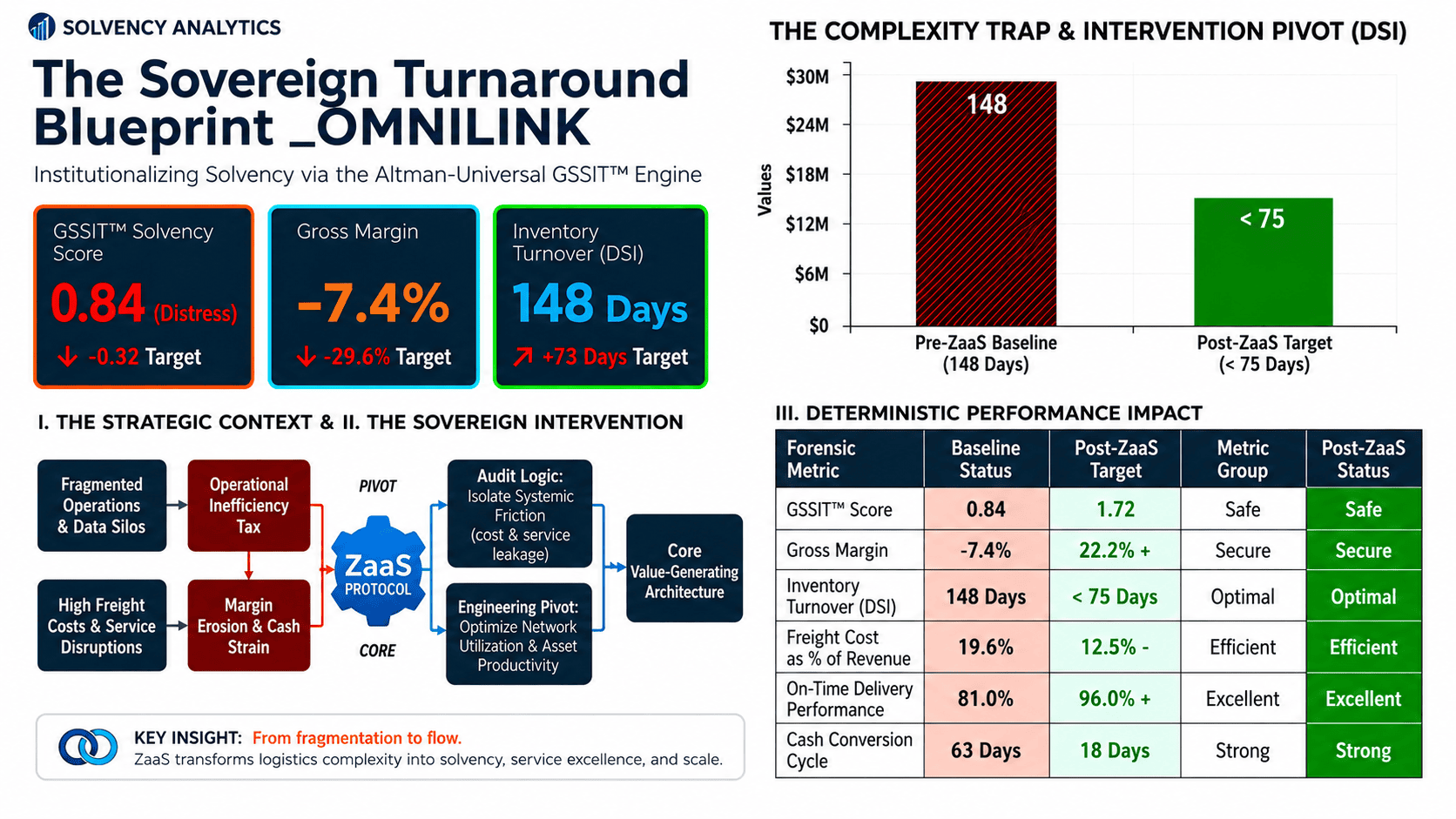
The Omni-Link™ V5.0 deployment represents a strategic transformation from reactive manufacturing to predictive, intelligence-driven operations. By deploying the Omni-Link™ architecture, we exposed and eliminated hidden operational bottlenecks that conventional ERP systems failed to detect—including micro-leakage, thermal congestion, cognitive fatigue, and financial latency—creating a unified operational intelligence layer across the production environment. This intervention fundamentally strengthened enterprise resilience, recovering the Altman Z-Score from a vulnerable 1.9 (Grey Zone) to a secure 2.8 while improving the Global Strategic Solvency Metric (GSSM) from 0.62 to 0.89. Central to this performance breakthrough was the synchronization of shop-floor operations with financial intelligence, compressing production cycle time by more than 68%, reducing material scrap by over 94%, and increasing direct labor efficiency from 72% to 94%.
Nova Freight - Loose Logistics Latency
As global logistics networks become increasingly dynamic, maintaining alignment between freight operations, carrier capacity, customer commitments, and financial performance becomes exponentially more challenging.
Nova Freight leveraged the AI Universal Engine™ to unify these interconnected variables into a predictive logistics intelligence framework.
Through forensic diagnostics, real-time economic modeling, and strategic simulation, the Engine exposed hidden operational friction, routing inefficiencies, and financial leakage while identifying opportunities to optimize capacity, reduce decision latency, and improve margin performance.
Leadership gained the ability to anticipate disruption, validate strategic decisions before execution, and respond proactively to changing market conditions.
AI Universal Engine™ Snapshot
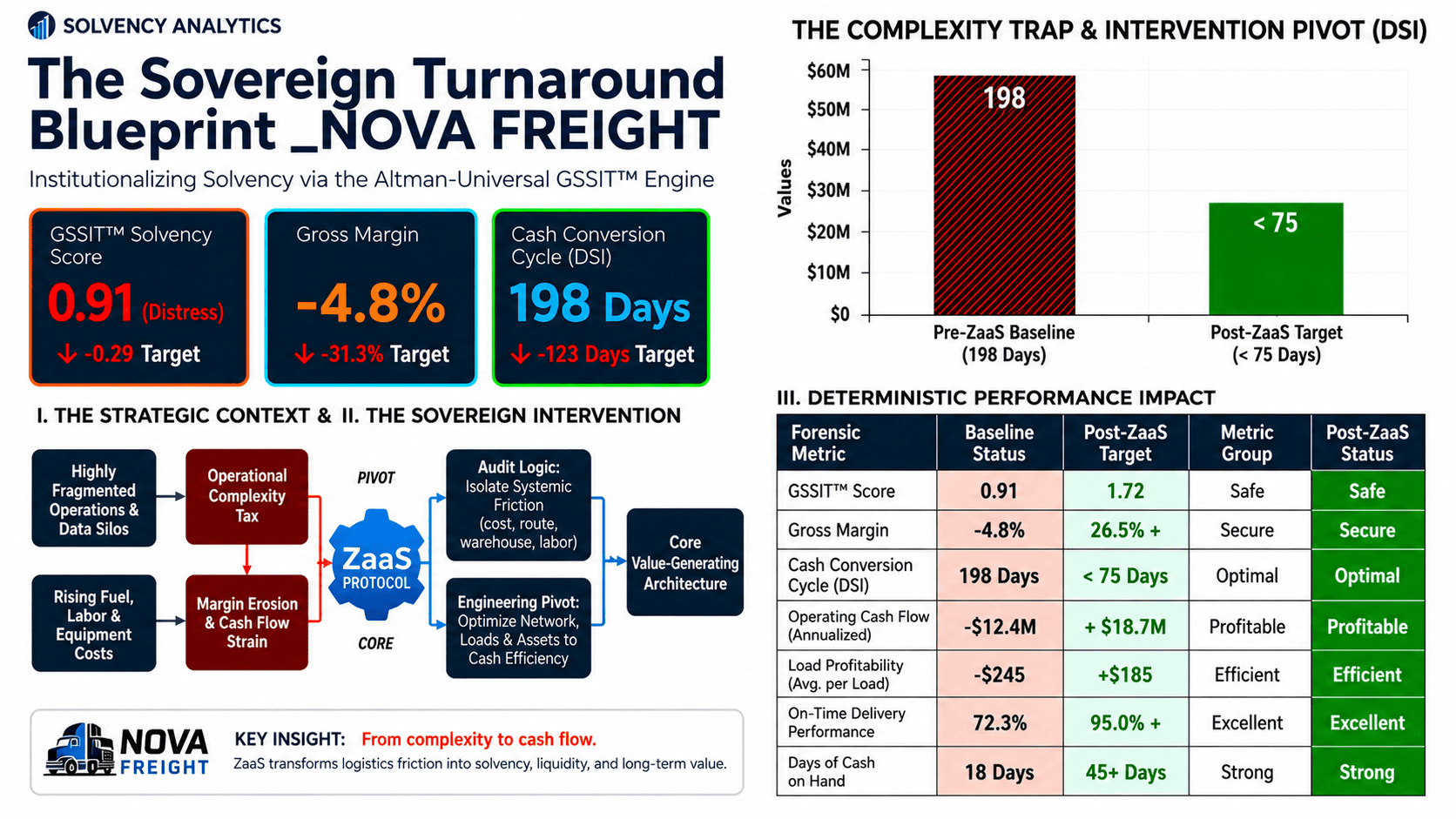
The Nova Freight transformation illustrates the shift from reactive freight brokerage to predictive, AI-driven logistics intelligence. Using the A.P.E.X.™ execution architecture, the AI Universal Engine™ identified hidden operational friction caused by manual booking, routing inefficiencies, and model decay—replacing static historical decision-making with real-time predictive execution. The analysis uncovered more than $4.2 million in annual value leakage, reduced decision latency from 3.5 hours to 0.04 seconds, and projected gross margin improvement from 12.0% to 17.5% through intelligent contract optimization and dynamic routing. By integrating Population Stability Index (PSI) monitoring, Expected Value (EV) modeling, and continuous market validation, the Engine enables organizations to anticipate volatility, weather disruptions, and capacity constraints before they impact operations. The result is a synchronized logistics enterprise where operational execution and financial intelligence work together—creating faster decisions, stronger margins, greater resilience, and a sustainable competitive advantage in an increasingly volatile freight marketplace.

Discover What's Limiting Your Next Level of Growth
The AI Universal Engine™ reveals hidden friction, identifies strategic opportunities, and helps leaders make better decisions with greater confidence.
Schedule your complimentary discovery conversation today.
Or, take immediate advantage of The Sovereign Pilot Initiative.